

Record Wednesday, May 20, 2026
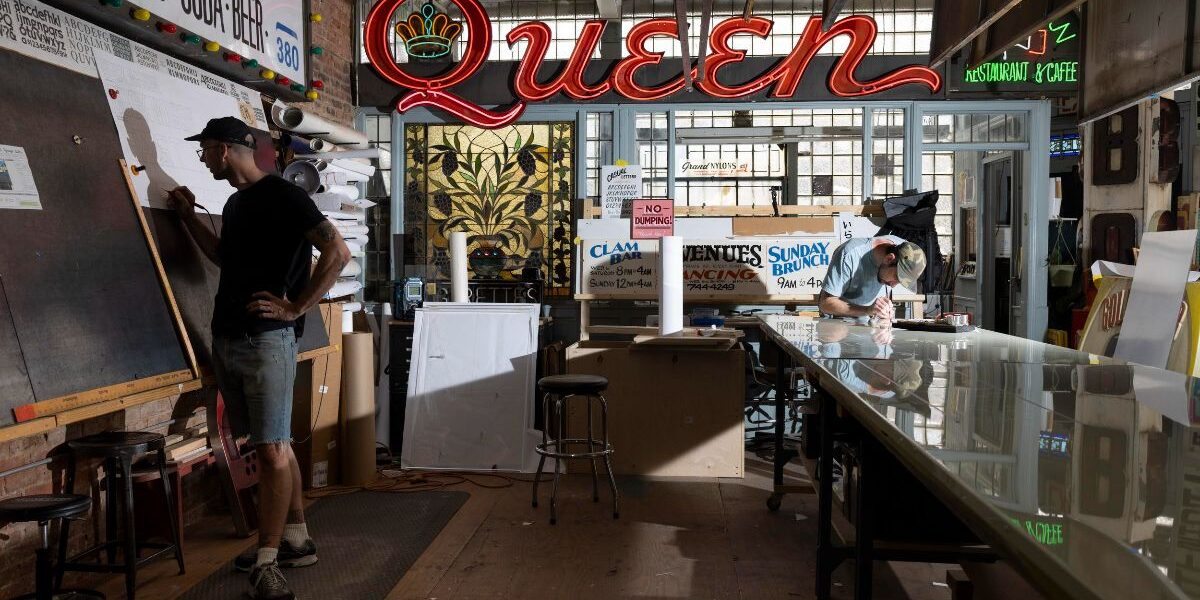
David Barnett – Vernacular Spectacular: Preserving New York’s Signs and Stories
What makes a sign quintessentially New York, and what do our old signs tell us about who we are as New Yorkers? This talk dives into the city’s vernacular signage tradition, from hand-painted storefronts to neon spectaculars, tracing how design, craft, and identity intersect in the urban landscape. Drawing from his work as the Director of the New York Sign Museum, David Barnett, co-founder of Noble Signs, will examine how signs act as both design artifacts and vessels of collective memory, preserving the human stories, neighborhoods, and visual language that give the city its soul.
In an age of homogenized branding, this talk makes a case for why saving old signs isn’t just about nostalgia, but about reclaiming ownership of our city’s shared visual history. Our goal is to show how codifying and preserving the New York style is a mission that can both lift design as well create positive change at the local level.
00:00:04.000 –> 00:00:09.000
Welcome to our 72nd monthly Zoom presentation
00:00:09.000 –> 00:00:14.000
Another milestone on the journey we embarked on those long ago days of the pandemic
00:00:14.000 –> 00:00:23.000
We can all be very proud of the amazing library of recordings that we’re building. It’s truly a testament to the diversity of the roadside.
00:00:23.000 –> 00:00:30.000
I’m Brian Gallagher, the president of the Society for Commercial Archaeology, and proud to be your host for tonight’s presentation.
00:00:30.000 –> 00:00:39.000
Welcome to all our guests and to any new people we have with us. We’re happy you took the time to watch an SCA presentation. I hope you enjoy the show.
00:00:39.000 –> 00:00:47.000
And for those watching the recording of this episode of the SCA’s monthly presentations, who is not a member of the SCA
00:00:47.000 –> 00:00:50.000
We earnestly ask you to consider joining
00:00:50.000 –> 00:00:55.000
Funding for the various activities of the SCA comes almost exclusively from our membership
00:00:55.000 –> 00:01:05.000
Just visit our website at www.sca-roadside.org and follow the links.
00:01:05.000 –> 00:01:17.000
Tonight we will have Jeremy Ebersel, who will be handling the questions and answers at the end of the presentation. And I know that he will do a great job for you tonight.
00:01:17.000 –> 00:01:21.000
Now I have the pleasure of introducing this month’s presenter.
00:01:21.000 –> 00:01:33.000
David Barnett is about to tell us all about vernacular spectacular, preserving New York signs and stories. What makes a sign quintessentially New York?
00:01:33.000 –> 00:01:40.000
This presentation will dive into the city’s vernacular signage tradition from hand-painted storefronts
00:01:40.000 –> 00:01:47.000
to neon spectaculars, tracing how design, craft, and identity intersect in the urban landscape.
00:01:47.000 –> 00:02:02.000
Drawing from his work as the director of the New York Sign Museum, David Barnett co-founder of Noble Signs will examine how signs act as both design artifacts and vessels of collective memory, preserving the human stories
00:02:02.000 –> 00:02:07.000
neighborhoods and visual language that give the city its soul.
00:02:07.000 –> 00:02:09.000
In an age of homogenized branding
00:02:09.000 –> 00:02:13.000
This talk makes a case
00:02:13.000 –> 00:02:17.000
For a wise saving old signs isn’t just about nostalgia
00:02:17.000 –> 00:02:23.000
What about reclaiming ownership of our city’s shared visual history
00:02:23.000 –> 00:02:35.000
Our goal is to show how codifying and preserving the New York style is a mission that can both lift design as well as create positive change at the local level
00:02:35.000 –> 00:02:42.000
David Barnett was born in 1986. He was a graphic artist and preservationist from New York City.
00:02:42.000 –> 00:02:49.000
As a creative director, he has worked in design, illustration, apparel, publishing, branding, and signage.
00:02:49.000 –> 00:02:51.000
In 2013
00:02:51.000 –> 00:03:02.000
He co-founded his own studio called Noble Science, specializing in branding and signage rooted in New York vernacular lettering traditions.
00:03:02.000 –> 00:03:09.000
As an extension of this mission, in 2019, he created the New York Sign Museum
00:03:09.000 –> 00:03:16.000
A 501c3 nonprofit dedicated to preserving 20th century advertising from the New York metropolitan area.
00:03:16.000 –> 00:03:21.000
He is a graduate of the type at Cooper Extended Program
00:03:21.000 –> 00:03:36.000
And a recipient of the TDC Ascenders Award. His work has been profiled in the New York Times, the New Yorker, Gothamist, ArtNet, WNYC, Hypoallergic, ABC News, NBC New York
00:03:36.000 –> 00:03:42.000
NHK, and more. Let’s welcome David as he gives us
00:03:42.000 –> 00:03:49.000
The 72nd SCA Zoom presentation
00:03:49.000 –> 00:04:02.000
David, I’d like to start sharing your screen.
00:04:02.000 –> 00:04:09.000
Let’s see if we have David coming on.
00:04:09.000 –> 00:04:11.000
We can hear you perfectly. So let me just restart the recording here or resume it, and you’re ready to go. Okay.
00:04:11.000 –> 00:04:12.000
Okay, take it away.
00:04:12.000 –> 00:04:42.000
Great. Thank you, Brian, and thank you all for joining me. Let me just get my screen share set up, and then we’ll… we’ll dive in.
00:04:42.000 –> 00:04:46.000
Alright. Fantastic. Um…
00:04:46.000 –> 00:04:48.000
Okay, that’s great, David, we can see it. It looks good.
00:04:48.000 –> 00:04:51.000
Okay, excellent.
00:04:51.000 –> 00:05:00.000
Hello, good evening, um, thanks for joining me tonight, and thanks to SCA for giving me a chance to talk about something I…
00:05:00.000 –> 00:05:05.000
feel very strongly about New York City signage.
00:05:05.000 –> 00:05:13.000
I love talking about what makes New York signage so special and unique to me, and how that informs the work that we do, both with our studio, Noble Signs, and non-profit, the New York Sign Museum.
00:05:13.000 –> 00:05:24.000
I begin designing and learning to paint signs in 2010, and from the onset tried to locate that practice in response to the visual culture of New York City.
00:05:24.000 –> 00:05:29.000
I could already see, then, that these signs that made New York City feel special and unique, that represented the visual character,
00:05:29.000 –> 00:05:35.000
of the city I’d grown up knowing, but had in a way, always taken for granted, were quickly disappearing.
00:05:35.000 –> 00:05:39.000
Inspired by the work of Stephen Powers and James and Carla Murray,
00:05:39.000 –> 00:05:41.000
We tried to have noble signs act as a counter to this.
00:05:41.000 –> 00:05:48.000
If we were going to be putting work out into the New York City streetscape, we wanted to design it with context and respect for our local area.
00:05:48.000 –> 00:05:53.000
Sometimes that meant exercising self-control to design not trying to reflect myself,
00:05:53.000 –> 00:06:01.000
But really, with the more universal lens, to capture some of that iconic New York style that was already vanishing and multiply it back into the streetscapes.
00:06:01.000 –> 00:06:16.000
And I suddenly became obsessed and inspired by this energy that I could see running through him handmade signage from New York in the 20th century. It had a quality, a personality and flavor that evoked both the artists who made it and the business owner who commissioned it.
00:06:16.000 –> 00:06:23.000
Real New Yorkers with their own diverse backgrounds and experiences who still found common ground and were part of a shared collective identity.
00:06:23.000 –> 00:06:26.000
And you could really see that in the work.
00:06:26.000 –> 00:06:30.000
a vernacular is the native language or dialect of a specific group of people.
00:06:30.000 –> 00:06:36.000
In New York City, there’s a visual vernacular. To 20th century lettering and signage, an aesthetic that
00:06:36.000 –> 00:06:39.000
I feel we can tie to this specific place and time.
00:06:39.000 –> 00:06:49.000
Vernaculars are learned locally, not in a classroom, or from books, but person-to-person and from observing the world around you. The signage trait in particular operated in this way.
00:06:49.000 –> 00:07:02.000
While there was a signed graphics trade school on the East Coast until the early 2010s, most sign painters came up through an apprentice system, either sitting with an individual painter, or as part of one of the many sign shops that existed here over the course of the 20th century.
00:07:02.000 –> 00:07:05.000
And of course, there were others who were self-taught.
00:07:05.000 –> 00:07:13.000
New York then has now contained all levels of skilled tradespeople, from amateurs to masters of their craft. And you can see that mixing, uh, the high and low,
00:07:13.000 –> 00:07:17.000
Uh, in many New York streets, like the one pictured here.
00:07:17.000 –> 00:07:27.000
But whether they were a skilled artisan or just an amateur practitioner, you could see that these artists were producing work that had certain similarities.
00:07:27.000 –> 00:07:33.000
bold lettering, primary colors, alphabets designed for speed, and maximum impact.
00:07:33.000 –> 00:07:38.000
The work needed to be produced fast and stand out in the crowd, and you needed to be able to read it.
00:07:38.000 –> 00:07:45.000
So, with Noble Signs, we set out to study this vernacular to decode what made it resonate with us so deeply on such a personal level.
00:07:45.000 –> 00:07:56.000
And to answer this question, what is this New York style, beyond just, you know it when you see it? What define the aesthetic and feel of this old New York, the one I pictured in my mind’s eye when I think back to being a kid?
00:07:56.000 –> 00:08:00.000
And what made it so special and unique?
00:08:00.000 –> 00:08:07.000
This has gradually become the center of my design practice for the last 15 years, and Noble Science has grown to a team of 15 people.
00:08:07.000 –> 00:08:13.000
designers, artists, archivists, and craftspeople working together to keep this local style alive in our streetscape.
00:08:13.000 –> 00:08:22.000
Our research-based approach looks to the layered history of the world around us to steward the New York vernacular design and sign-making traditions into the future.
00:08:22.000 –> 00:08:26.000
As an extension of this mission, we established the New York Sign Museum in 2021.
00:08:26.000 –> 00:08:38.000
A non-profit 501c3 foundation, archive, gallery, and living art project dedicated to preserving and educating people about the city’s lettering, advertising, and signage traditions.
00:08:38.000 –> 00:08:46.000
Housed in our East Brooklyn studio. The museum now hosts public tours, lettering workshops, and community events that reconnect people to the city’s visual identity.
00:08:46.000 –> 00:08:55.000
Our growing collection of over 200 historic storefront signs from Essex Card Shop to Kiskaya Supermarket offers a link to New York’s past.
00:08:55.000 –> 00:09:01.000
We started saving signs both to study them and as a counter to the cultural erasure we saw happening around us.
00:09:01.000 –> 00:09:09.000
It was an act of protest, done out of emotional necessity, from that pain of seeing something beautiful being thrown in the trash.
00:09:09.000 –> 00:09:15.000
The deeper layer that emerged is what these signs mean to us all, and what they represent at the human level.
00:09:15.000 –> 00:09:20.000
Pictured here, you see one of the first signs I ever saved for my corner bodega in Crown Heights on Franklin Ave.
00:09:20.000 –> 00:09:27.000
Um, I carried this sign up the stairs to my third floor walk-up, where you see it in this photo.
00:09:27.000 –> 00:09:36.000
And there was a… it was a deli that I had… I had been talking to them about the signs for years, and I told them, you guys really shouldn’t change these signs, you shouldn’t throw them out.
00:09:36.000 –> 00:09:43.000
They did change them, and then within a year, they actually, uh, closed, and it was replaced by a Dunkin’ Donuts, which…
00:09:43.000 –> 00:09:47.000
Strangely, recently closed as well, and now the store front’s vacant.
00:09:47.000 –> 00:09:49.000
Handmade signs in storefronts,
00:09:49.000 –> 00:09:55.000
truly do define our lived experience as New Yorkers, uh, and bring meaning to our daily lives.
00:09:55.000 –> 00:10:00.000
When you walk out of your door every day and you see these signs that were made by your neighbors, for your neighbors,
00:10:00.000 –> 00:10:02.000
It creates a feeling of belonging.
00:10:02.000 –> 00:10:06.000
a sense of place and a sense of neighborhood itself.
00:10:06.000 –> 00:10:08.000
There’s this idea that by extension, I think,
00:10:08.000 –> 00:10:12.000
the signs were made for you, too, and they invite you in,
00:10:12.000 –> 00:10:18.000
for a coffee, or sometimes just to chat after a long day. Signs become visual markers of our communities.
00:10:18.000 –> 00:10:22.000
landmarks, meeting places, hung on venues for celebrations, both big and small.
00:10:22.000 –> 00:10:28.000
And when this culture vanishes, replaced by global chain stores with generic signs that erase local character,
00:10:28.000 –> 00:10:31.000
This feeling of uniqueness goes with it.
00:10:31.000 –> 00:10:36.000
Signs are symbols. They express community, identity, history, and local pride.
00:10:36.000 –> 00:10:40.000
And when we lose them, we lose part of who we are.
00:10:40.000 –> 00:10:45.000
Hand lettering is naturally carrying over some of the quality of the person who made it.
00:10:45.000 –> 00:10:51.000
And I think in this way, our vernacular lettering contains all sorts of big and boisterous New York personalities.
00:10:51.000 –> 00:10:57.000
The cultural diversity of our city is reflected in its visual diversity, and yet it all seems to fit together.
00:10:57.000 –> 00:11:00.000
In an eclectic, if sometimes messy, way.
00:11:00.000 –> 00:11:04.000
The broader visual vernacular of New York streetscapes shows a shared respect for restraint.
00:11:04.000 –> 00:11:09.000
We don’t like to waste each other’s time. Uh, it’s direct, it’s playful, it’s inviting.
00:11:09.000 –> 00:11:17.000
It makes you feel like you’re home. And that feeling means something, and it’s what we’re trying to capture in our work.
00:11:17.000 –> 00:11:25.000
Noble Signs is a multidisciplinary creative studio based in New York City, founded by myself and my partner Mac Bahanka in 2013.
00:11:25.000 –> 00:11:31.000
Our company began with a twin focus on design and craft manufacturing. We’ve preserved that ethos over the past decade.
00:11:31.000 –> 00:11:38.000
Uh, here you see us working on some early projects in our first shop, which was in the basement of Mac’s apartment, uh, in Bed-Stuy.
00:11:38.000 –> 00:11:49.000
And here we are in our current home in East New York. Um, we relocated to this unique pre-war factory building in 2018.
00:11:49.000 –> 00:11:53.000
Our mission as a studio is to create storefronts, brand identities, and artworks that speak to history and the present moment.
00:11:53.000 –> 00:11:59.000
We want New York City to continue to have a unique visual identity, and by keeping these local styles alive,
00:11:59.000 –> 00:12:03.000
We hope to create a positive effect in the place that we live and work.
00:12:03.000 –> 00:12:10.000
we’re making signs that are gonna be in the environment that we walk through every day, and that our friends and neighbors walk through, and that’s…
00:12:10.000 –> 00:12:15.000
there’s a certain responsibility that comes with that. We try not to take it lightly.
00:12:15.000 –> 00:12:22.000
Our practice exists in response to shifts in technology, culture, design trends, and the urban environment.
00:12:22.000 –> 00:12:25.000
By treating design as a live medium rather than a static product,
00:12:25.000 –> 00:12:31.000
this extends beyond design into cultural practice. Experimental preservation, and social intervention.
00:12:31.000 –> 00:12:37.000
As a studio, but also as a public space manufacturing facility, and a cultural participant.
00:12:37.000 –> 00:12:40.000
We’re deeply embedded in the visual economy of New York.
00:12:40.000 –> 00:12:48.000
We design with context, not from within a vacuum, and this is really key to everything that we do.
00:12:48.000 –> 00:12:55.000
And as our works expanded beyond signage into branding, campaigns, public art, we’ve continued to maintain that approach.
00:12:55.000 –> 00:13:00.000
We work where designing collective memory meet to reimagine craft as a living situated act.
00:13:00.000 –> 00:13:10.000
We want to locate our work within this New York vernacular, but also show how this type of hyperlocal design thinking can light a path towards a better future.
00:13:10.000 –> 00:13:12.000
Our studio approach is deeply research-based.
00:13:12.000 –> 00:13:27.000
Our process always begins with a pencil, but we also work digitally. We use all modern tools at our disposal to offer the best quality product in the most efficient manner to our partners. It’s really important to us that our work remain accessible to everybody. Um, we want
00:13:27.000 –> 00:13:31.000
you know, the smallest of small businesses to be able to have a beautiful sign.
00:13:31.000 –> 00:13:42.000
So we draw from our archive of signage, photography, publications, and we look to locate many of our storefront projects with some kind of anchor that connects them to local history and to our collective memories.
00:13:42.000 –> 00:13:44.000
We really feel that craft itself
00:13:44.000 –> 00:13:48.000
can be a living act, and that materials themselves can carry meaning.
00:13:48.000 –> 00:13:53.000
For this reason, we favor bespoke techniques, hand painting, neon, gold leaf,
00:13:53.000 –> 00:13:55.000
Handwork metal fabrication,
00:13:55.000 –> 00:14:06.000
Not just because they look better, which they do, but because the skilled touch that they require naturally imparts some of that work with the humanity of the people that make it.
00:14:06.000 –> 00:14:13.000
Our ways of working are definitely unique. Um, our designs are mostly lettering-based, but we rarely use fonts. Instead, drawing
00:14:13.000 –> 00:14:19.000
Our letter forms out by hand, and then scaling it for production from pencil sketch to final execution.
00:14:19.000 –> 00:14:24.000
So, in this way, we’re able to channel the New York vernacular into our work in both inspiration and application.
00:14:24.000 –> 00:14:30.000
the designs are inspired by history and created by hand to maintain that human connection that can only come from a person.
00:14:30.000 –> 00:14:32.000
And there’s a certain…
00:14:32.000 –> 00:14:41.000
humanity in handmade work, right? It has a… it has those little imperfections and inconsistencies that…
00:14:41.000 –> 00:14:47.000
you might not consciously recognize, but there’s this idea of unseen effort, right? Something that…
00:14:47.000 –> 00:14:58.000
you’re… you can see it out of the corner of your eye, and you could sense that there’s a human presence in it, because it’s not perfect, and I think that imperfection is really, um, it’s really important, and it’s something that we…
00:14:58.000 –> 00:15:01.000
try to make sure isn’t lost in our work.
00:15:01.000 –> 00:15:15.000
And we do, you know, look to reference points and recontextualize them into new concepts. Um, oftentimes kind of blenderizing things together, but sometimes we’re so inspired by a classic storefront, we find a way to directly link it to a new project.
00:15:15.000 –> 00:15:24.000
This is kind of our way of continuing a thread that was abruptly ended, as most of these signs disappear from our streets overnight.
00:15:24.000 –> 00:15:29.000
we can bring this friendly design ghost back from the dead and give it new life.
00:15:29.000 –> 00:15:33.000
With a business that’s actually positioned to the present and the future.
00:15:33.000 –> 00:15:36.000
Um, I can share with you just a few of those projects now.
00:15:36.000 –> 00:15:43.000
Um, this is a civil service bookshop, which had been on Worth Street in Phye since the 1960s and closed in the 2010s.
00:15:43.000 –> 00:15:55.000
This is one of those stories that was sparked by my collector’s itch. Um, I actually saw this sign on Facebook Marketplace a few years ago. Uh, it had been taken down when the shop closed, and someone had
00:15:55.000 –> 00:15:57.000
to unframed it and…
00:15:57.000 –> 00:16:02.000
broken all the panels into little pieces, and they had it sitting around, and they listed it.
00:16:02.000 –> 00:16:04.000
you know, we’re…
00:16:04.000 –> 00:16:12.000
we’re a non-profit, we’re not in the business of buying signs, typically. We try to, um, mostly save things that people are
00:16:12.000 –> 00:16:17.000
actually going to be throwing away, but in this case, someone else has saved that they were looking for some cash for it.
00:16:17.000 –> 00:16:30.000
We kind of deliberated about it, it was a great… I mean, it’s such a cool sign. It really speaks to me personally. I think there’s a lot about this sign that I just… I… I really love. Um, and we finally decided, okay, we’re gonna make an offer on it.
00:16:30.000 –> 00:16:34.000
And when we went to do it, the guy said, oh man, I just sold it.
00:16:34.000 –> 00:16:47.000
Um, so, you know, that’s, uh, I think the type of person I am. That kind of thing really, uh, can haunt me for weeks, and I’ll wake up, uh, every morning,
00:16:47.000 –> 00:16:53.000
day after day, being like, damn it, why didn’t we buy that sign? It was… it was… it was really special.
00:16:53.000 –> 00:16:57.000
But, as luck would have it, a project came around, um…
00:16:57.000 –> 00:17:10.000
for, uh, City Councilmember Justin Brannon, and he was like, I just want you guys to do what you do, you know, have fun with it. Um, and the first thing I thought of was the civil service bookshop sign. Um…
00:17:10.000 –> 00:17:15.000
I brought it to him, I showed him the reference, I was like, we kind of just want to do this, how do you feel about that? He’s like, yeah, let’s go.
00:17:15.000 –> 00:17:23.000
So, here you can see a bit about, you know, how we… how we approach it. We start with a pencil sketch, um, and then…
00:17:23.000 –> 00:17:27.000
we do ultimately fully digitize work for production, because…
00:17:27.000 –> 00:17:33.000
this is large format work, right? You… you… if you’re gonna draw it out by hand, you’d have to be drawing it out
00:17:33.000 –> 00:17:36.000
at full scale, which is…
00:17:36.000 –> 00:17:42.000
gonna be very time-consuming, not impossible, it’s how the old signs were made, but for us, it’s like,
00:17:42.000 –> 00:17:45.000
we’re trying to be efficient, so we’ll draw it out.
00:17:45.000 –> 00:17:55.000
you know, at a smaller size, and then we’ll bring it in to the computer, digitize it, and then produce patterns that then get pounced for painting. I’ll explain a little bit more about that process in a minute.
00:17:55.000 –> 00:17:59.000
But you can also see one thing that we like to do, um…
00:17:59.000 –> 00:18:03.000
the way we present color-ups in this image on the right,
00:18:03.000 –> 00:18:06.000
uh, is directly inspired by the way, um,
00:18:06.000 –> 00:18:13.000
old sign makers in the 20th century would show their work. Some of you may have seen color-ups like this.
00:18:13.000 –> 00:18:16.000
from, uh, from old signed documents.
00:18:16.000 –> 00:18:26.000
Um, what we love about this, and you know, originally the people who were doing mock-ups like this were only colorizing a sliver of the sketch, because
00:18:26.000 –> 00:18:33.000
it was just faster. I mean, it’s the same thing, right? We’re always trying to save time in the sun industry. That hasn’t changed in the last 100 years.
00:18:33.000 –> 00:18:37.000
But, um… what I like about doing this is
00:18:37.000 –> 00:18:51.000
I think it requires the collaborator to use their imagination a little bit, and to not assume that the thing that they see on the screen is gonna be exactly what they get. And that’s an assumption that we have only recently, um,
00:18:51.000 –> 00:18:54.000
adopted as a society, and I think, you know,
00:18:54.000 –> 00:18:58.000
it’s… there’s a lot of, um…
00:18:58.000 –> 00:19:11.000
there’s a danger in things being so accessible, fully digitized, and then you’re sharing it, you end up getting this, like, design-by-committee where it gets forwarded to 10 different people, and they all have to say yes before it gets made.
00:19:11.000 –> 00:19:15.000
A lot of the way we work is about kind of circumventing some of that.
00:19:15.000 –> 00:19:20.000
That way of working, and trying to go back to a more simple way, where
00:19:20.000 –> 00:19:24.000
sign… like, a lot of these amazing signs that we love, in fact, probably all of them.
00:19:24.000 –> 00:19:30.000
We’re essentially approved from a sketch with some color notes, just like you see here, and it allowed the person who was making them
00:19:30.000 –> 00:19:40.000
to have more freedom, more flexibility, and ultimately to make work that was more personal to them. So we try to preserve that in our process.
00:19:40.000 –> 00:19:51.000
And then once we have an approved sketch, we take it to Vector, we scale it to size, um, this is a really large sign. You can see here a little bit of our process.
00:19:51.000 –> 00:19:59.000
Um, we use, I guess, an ASMR in here. We use, um, it’s called a pounce method. Uh, this is the…
00:19:59.000 –> 00:20:05.000
traditional method for pattern transfer goes back to at least the Renaissance. Essentially, what you’re doing is
00:20:05.000 –> 00:20:11.000
perforating artwork, uh, with, um, very small dots, and then you’re using chalk dust,
00:20:11.000 –> 00:20:17.000
to pass through it, to transfer it onto a substrate, in this case an aluminum panel. Um, we custom mix…
00:20:17.000 –> 00:20:23.000
enamela paint, and we both spray and brush letter here in our studio.
00:20:23.000 –> 00:20:25.000
And, um…
00:20:25.000 –> 00:20:29.000
then, you know, it’s all painted with, uh, with brushes.
00:20:29.000 –> 00:20:34.000
Um, just like the old signs were made. So, yeah, we have a… we have a really…
00:20:34.000 –> 00:20:39.000
A really interesting process, I think it’s… it’s… it’s both…
00:20:39.000 –> 00:20:43.000
modern, but it’s also very much inspired by the past.
00:20:43.000 –> 00:20:47.000
Uh, here you can see a shot of the sign, um,
00:20:47.000 –> 00:20:54.000
a little bit further along in the process, in our studio, um, and then here you can see the finished piece in situ.
00:20:54.000 –> 00:21:07.000
Um, and I’m pleased to say that this piece was actually just recognized for a TDC award in this year’s competition, which was very cool, because it’s, uh, it’s definitely something a little bit unusual, and um…
00:21:07.000 –> 00:21:14.000
it’s very neat to see that people respond to work like this in that way, because we love it.
00:21:14.000 –> 00:21:17.000
It’s just some details.
00:21:17.000 –> 00:21:19.000
And again, you know, a piece like this…
00:21:19.000 –> 00:21:25.000
these… these smaller bits, like, these never get vectorized, we just letter these freehand.
00:21:25.000 –> 00:21:31.000
When you’re dealing with, uh, smaller copy, working off the brush, freehand lettering is, like,
00:21:31.000 –> 00:21:36.000
a natural way to approach it. Um, you just kind of let the brush dictate the letter forms.
00:21:36.000 –> 00:21:53.000
When you’re doing bigger lettering, like the green lettering you see here, um, you know, even back in the day, that wasn’t going to be done freehand. It’s too big, there aren’t brushes that could paint a letter like that in a single stroke, so that would be what we… sign painters would call built-up lettering. It’s always drawn out first and then filled in with the brush.
00:21:53.000 –> 00:21:57.000
Um, I think one of the things I love about this sign is how it mixes both.
00:21:57.000 –> 00:22:01.000
Um, here’s another interesting project, um…
00:22:01.000 –> 00:22:05.000
This is Glazer’s Bake Shop, um, which was in Manhattan.
00:22:05.000 –> 00:22:11.000
Uh, I believe for 60 or 70 years, it closed, um…
00:22:11.000 –> 00:22:20.000
around the pandemic, and this was just one of my favorite storefronts in New York City. I just… I love everything about it. The colors, the storefront itself,
00:22:20.000 –> 00:22:23.000
Um, the…
00:22:23.000 –> 00:22:28.000
The lettering, the framing, I mean, it’s just a beautiful sign. Um, and we, um…
00:22:28.000 –> 00:22:33.000
we had the opportunity to collaborate with Radio Bakery. They’re a, um…
00:22:33.000 –> 00:22:41.000
a bakery in… originally in Greenpoint, Brooklyn, they were opening a second location in Prospect Heights, and they actually came to us, and they were like, we kind of want to…
00:22:41.000 –> 00:22:48.000
honor Glazer’s Bakery. Like, we grew up going there, it’s an awesome… it was an amazing spot, it’s… it inspired us, and we love the storefront.
00:22:48.000 –> 00:22:56.000
And again, I was like, yeah, let’s go. This is awesome. Let’s… let’s figure… let’s figure out how we can do glazers for… for you guys.
00:22:56.000 –> 00:23:05.000
This one was tricky, because we had to go through landmarks. Um, it’s in a historic district, um, that’s something we navigate a lot in our work.
00:23:05.000 –> 00:23:12.000
the LPC guidelines in New York are often restrictive, and to do something that’s, um, a little bit, uh,
00:23:12.000 –> 00:23:28.000
Strangely, to do something that’s more like a classic New York City sign, you have to go through community boards, because it won’t be approved at staff level. Um, so this was something we actually had to take to the community board, show them our intent, um,
00:23:28.000 –> 00:23:33.000
Pull historic photos, as you can see in the top, top right here, uh, show some precedent for what
00:23:33.000 –> 00:23:40.000
had been at that location previously, uh, scale of signage, type of material, uh, type of lettering.
00:23:40.000 –> 00:24:05.000
And, um, they actually came back, and they said, no, you need to make the sign smaller, we’ll allow you to make this type of sign, but it has to be smaller. And this is actually, you see here on the left, it’s like this, they wanted the sign to be centered on the storefront, but the storefront… or they wanted this time to be centered on the building, but the storefront isn’t centered to the building, and I just was like, we can’t do this. It’s just not… it’s not gonna look right, it’s not gonna look classic, it… it… you would never… they never would have made
00:24:05.000 –> 00:24:13.000
data sign like this, off-centered, not taking up the full real estate of the fascia. So, we went back to the community board,
00:24:13.000 –> 00:24:18.000
propose a wider sign with some slight modifications, and…
00:24:18.000 –> 00:24:21.000
they went for it. Um, so…
00:24:21.000 –> 00:24:25.000
we started fabricating, um…
00:24:25.000 –> 00:24:27.000
Here you see, uh…
00:24:27.000 –> 00:24:40.000
Ed and Bobby from the Noble team, making what… this is a type of letter, it’s ubiquitous in New York City signage from the 20th century. It goes by a lot of different names. Some people call it Jewelight. That’s the brand name that used to make this
00:24:40.000 –> 00:24:44.000
metal trim, but basically what this is is a plastic letter.
00:24:44.000 –> 00:24:49.000
that’s wrapped in a plastic metal trim, and it’s a… you know, I think…
00:24:49.000 –> 00:25:00.000
starting in the 1960s on, you see a lot of plastic letter signage popping up. Um, it was a new material, it was a way to bring dimensionality to signs that had traditionally been fully painted.
00:25:00.000 –> 00:25:10.000
And it was cheaper than making metal letters, um, but plastic itself, when it’s cut, you can make a nice sign. We have a lot of beautiful signs in our collection that are just plastic cut letter.
00:25:10.000 –> 00:25:23.000
Um, especially early plastics. Um, but adding this trim band around the edge, it creates, you know, presence, depth, uh, play of light, shadow, so it’s a really neat way to, um, elevate
00:25:23.000 –> 00:25:29.000
a sign that is essentially pretty simple and can be fully handmade, so…
00:25:29.000 –> 00:25:35.000
Um, you know, we laser cut these letters, and then we hand trim them. Traditionally, they were cut with, like, a jigsaw. Um…
00:25:35.000 –> 00:25:42.000
But it’s a pretty… it’s a pretty tough process. Um, you can kind of see how it’s done, where you…
00:25:42.000 –> 00:25:45.000
use, uh, heavy nails to basically
00:25:45.000 –> 00:25:57.000
tight wrap trim around the letter, and then you, uh, you glue it together. So, it’s a very, uh, labor-intensive hand process, but those are the kind of things that we really like to do.
00:25:57.000 –> 00:25:59.000
Um…
00:25:59.000 –> 00:26:02.000
And you can see a little bit more here, um…
00:26:02.000 –> 00:26:09.000
background being custom sprayed. We spent a lot of time mixing this color to make sure that it really spoke to the glazer’s sign.
00:26:09.000 –> 00:26:16.000
Um, and that beautiful color that that sign was. And here you see us installing, and…
00:26:16.000 –> 00:26:23.000
the finished sign, uh, next to the reference.
00:26:23.000 –> 00:26:26.000
One more I’ll talk about, um…
00:26:26.000 –> 00:26:28.000
This one is a… is a bit…
00:26:28.000 –> 00:26:32.000
it’s not quite as clear a through-line, but I think this is, like,
00:26:32.000 –> 00:26:41.000
a really neat sign. Well, first of all, this is one of my favorite historic New York City signs. This sign actually lives on at the American Sign Museum in Cincinnati. If you haven’t been,
00:26:41.000 –> 00:26:48.000
definitely go check it out. Um, they have an amazing collection, and they’re wonderful people, um, and very happy that they preserved this sign.
00:26:48.000 –> 00:26:57.000
Um, this was one that definitely hurt. I know it hurt a lot of people in New York to see it go. Uh, it’s a beautiful sign, it was a great, a great…
00:26:57.000 –> 00:27:01.000
Delhi, and um… it’s a really unusual construction.
00:27:01.000 –> 00:27:09.000
Um, you know, there’s a lot of signs that… neon signs that use what we call raceways, those are these, um…
00:27:09.000 –> 00:27:19.000
the channel, this, like, long conduit channel that the delicatessent lettering is on, um, a raceway is, like, a great way to basically
00:27:19.000 –> 00:27:24.000
not have a full cabinet for a neon, and to have, um…
00:27:24.000 –> 00:27:34.000
electronics and all that stuff have a place to live, but having, like, a low profile on the storefront, but this was a really interesting example, because it not only had race… lettering-mounted
00:27:34.000 –> 00:27:39.000
to the front of the raceway, it also had neon channel lettering, sitting on a ledge on the top.
00:27:39.000 –> 00:27:41.000
Um, so…
00:27:41.000 –> 00:27:53.000
we were working with Vaselka, um, one of my favorite, uh, historic New York businesses. Uh, they were opening their second location after 75 years in business, um, and they…
00:27:53.000 –> 00:28:09.000
had a vision for this, um, this sign that we were really interested in. They wanted to do a big… a couple big neon signs. Um, but the idea we originally had didn’t get approved by DOB, so we had to pivot to a sign that had less projection off the building, and
00:28:09.000 –> 00:28:15.000
still had a lot of presence, and I thought of that Clover Deli sign. So you can see here, we basically…
00:28:15.000 –> 00:28:21.000
Uh… adopted that idea of a raceway with neon channels sitting on top.
00:28:21.000 –> 00:28:37.000
Um, and it’s not a direct one-to-one with Clover Deli, but if you look at the details, we, um, we use this V from the Clover Deli sign and really modded our construction, um, on that classic sign that we love so much.
00:28:37.000 –> 00:28:42.000
Here you see some install. This sign had to get craned on the building.
00:28:42.000 –> 00:28:49.000
And here you see side-by-side. I think you can definitely see the influence.
00:28:49.000 –> 00:28:54.000
So yeah, we love the work that we do, and we hope that by reconnecting this
00:28:54.000 –> 00:29:01.000
Sadly, kind of broken tie between design and manufacturing, we can create these physical objects that are really grounded in
00:29:01.000 –> 00:29:17.000
humanity. We’ve always thought of our practice as sort of a throwback to what we think of as the golden age of sign making in New York, that post-war period, from the 40s through to the 1960s, when you had artists, designers really pushing forward creatively, innovating,
00:29:17.000 –> 00:29:23.000
But working alongside the craftspeople, right? The trades and the makers who are bringing these visions to life, um,
00:29:23.000 –> 00:29:30.000
Usually hand-in-hand, all together under one roof. And I think this connectivity between design and production, thinking and doing, these
00:29:30.000 –> 00:29:41.000
two arms working together are able to create things that are so spectacular, they’re almost unimaginable today.
00:29:41.000 –> 00:29:46.000
And we really hope that by bringing design and manufacturing back together in one physical space,
00:29:46.000 –> 00:29:55.000
Um, where we work, we can sort of touch at that greatness, and hopefully find a way to elevate those little details that turn something mundane like a sign into something that
00:29:55.000 –> 00:30:00.000
really speaks to you, and you might even call art.
00:30:00.000 –> 00:30:02.000
Uh, here’s another that says…
00:30:02.000 –> 00:30:09.000
video of, uh, another channel at our neon sign.
00:30:09.000 –> 00:30:17.000
Always a great moment when you’ve been building… looking at a sign like this for months, and you finally see it lit up.
00:30:17.000 –> 00:30:21.000
So, while the sign industry was once
00:30:21.000 –> 00:30:28.000
really a haven for artistic talent. It has been reshaped gradually, but dramatically since the advent of the vinyl plotter in the 1980s.
00:30:28.000 –> 00:30:41.000
And in that pre-computer era, you really couldn’t work at a sign shop without a basic understanding of hand lettering. Most people entered the trade at the lowest level, earning their stripes, painting an endless queue of no parking signs that were constantly in need.
00:30:41.000 –> 00:30:53.000
Because, you know, New Yorkers, we love to block each other’s driveways. Um, in fact, they were building on skills that had been learned in grade school when lettering was still commonplace, and really pedestrian. I think penmanship
00:30:53.000 –> 00:30:55.000
still mattered, because it was just a necessity.
00:30:55.000 –> 00:31:00.000
You needed to write a letter, make a flyer for a bake sale, a poster for a community event.
00:31:00.000 –> 00:31:09.000
You better hope that your lettering look good, because there wasn’t Kinko’s or FastSigns to help you, so you either hired a sign writer, or you did it yourself.
00:31:09.000 –> 00:31:12.000
And I know we can really stare at wonder with
00:31:12.000 –> 00:31:20.000
excuse me, I know we can really stare with wonder at an old handwritten letter or marvel at that beautiful handwriting our grandparents had.
00:31:20.000 –> 00:31:25.000
But I don’t think they were showing off, uh, they’d just been doing it this way their whole lives, and…
00:31:25.000 –> 00:31:30.000
it was muscle memory to them.
00:31:30.000 –> 00:31:42.000
The reality is that in their heyday, there was really nothing glamorous about having the seal to produce beautiful lettering, much less being a professional sign painter. In the mid-20th century, sign painters were even referred to as lettering mechanics.
00:31:42.000 –> 00:31:49.000
Which probably shows how the trade was regarded. It was just a job, right? Like any other, you knew how to draw, well…
00:31:49.000 –> 00:31:50.000
Here’s a good way to make a living.
00:31:50.000 –> 00:31:57.000
As evidence of this, uh, it was only after I’d been painting signs for about 4 or 5 years that I received a call from my grandfather in the Bronx.
00:31:57.000 –> 00:32:05.000
He said, oh, I heard from your mother that you’re painting signs. That’s what my dad did. And my brother, too. It was our family business, and they had a shop in Manhattan.
00:32:05.000 –> 00:32:12.000
in the Film Arts Building. Uh, you remember the address? The building’s still there. Um, he said they made all kinds of signs,
00:32:12.000 –> 00:32:20.000
primarily in the film and theater business, in the days when movie posters were still painted by hand, and… of course, my first question was, did you save anything?
00:32:20.000 –> 00:32:26.000
But… the answer is no. Um, I dug deep, I reached out to extended family,
00:32:26.000 –> 00:32:34.000
Just trying to find anything, but nobody had saved anything. I think it wasn’t really considered precious, and…
00:32:34.000 –> 00:32:40.000
It wasn’t thought of, um, as anything really special, it was just… there was such an abundance of
00:32:40.000 –> 00:32:42.000
beautiful signs and lettering that…
00:32:42.000 –> 00:32:59.000
there was really… it wasn’t something that really was considered worthy of saving. Um, it was only after my grandparents passed away years later that my uncle and I found this portrait of my great-grandfather at his easel, along with his business cards, buried in a box in their attic. Um…
00:32:59.000 –> 00:33:05.000
Ultimately, becoming proficient in lettering is less about natural talent and more about putting the time in to get it right.
00:33:05.000 –> 00:33:10.000
Uh, much like learning to play musical instruments, a challenge that requires hours and hours of practice.
00:33:10.000 –> 00:33:20.000
probably about 10,000 of them before it becomes effortless. And, you know, in our current era of constant distractions, this could seem like a really tough
00:33:20.000 –> 00:33:29.000
task, but I think once you’ve started that journey, you can find that it really does pay a lot of dividends, both in work and your personal life.
00:33:29.000 –> 00:33:31.000
there’s this deep…
00:33:31.000 –> 00:33:39.000
meditative quality that comes from doing skilled handwork, and it’s a sort of fulfillment that’s really lacking now for many.
00:33:39.000 –> 00:33:42.000
I can say for myself, I think
00:33:42.000 –> 00:33:49.000
becoming a letterer really did give me a confidence that I brought into a lot of other parts of my life, so I’m glad I…
00:33:49.000 –> 00:33:52.000
started on that journey.
00:33:52.000 –> 00:34:03.000
Um, it’s a mind-body connection, right? A belief in yourself that really can transcend that medium and, um, give you, uh,
00:34:03.000 –> 00:34:07.000
a certain confidence that you can… you can carry over to other things that you do.
00:34:07.000 –> 00:34:15.000
And here I am, uh, in peak pandemic, when I think I really finally hit my 10,000 hours, um, and look how happy I am.
00:34:15.000 –> 00:34:23.000
Um, if you’re interested in learning this skill, I highly recommend it. We do offer workshops here at the New York Science Museum.
00:34:23.000 –> 00:34:28.000
Um, but, you know, whether you’re intent on learning lettering or not, I do think, um,
00:34:28.000 –> 00:34:34.000
every designer can benefit from some direct involvement in the process of the work that they create, and depending on the field,
00:34:34.000 –> 00:34:39.000
that you’re in, you might have the ability to visit a factory, um,
00:34:39.000 –> 00:34:42.000
in your own city, or even neighborhood, but…
00:34:42.000 –> 00:34:44.000
you know, sadly, globalization has made that…
00:34:44.000 –> 00:34:50.000
pretty challenging, and the economic realities of making things by hand in America, much less New York City, are complex.
00:34:50.000 –> 00:34:57.000
In spite of that, we keep pushing forward with this model at Noble Signs, and we’re gonna keep doing it as long as we’re lucky enough to have
00:34:57.000 –> 00:35:04.000
partners who see the value.
00:35:04.000 –> 00:35:09.000
So, like many designers, I’ve been a collector my whole life, and once I started paying attention to old signs, I really couldn’t stop.
00:35:09.000 –> 00:35:24.000
the deeply emotional reaction I felt seeing some of these signs that I love, that I walk by every day, seeing them just disappear overnight, thrown in the garbage, it compelled me to start saving signs. Um, with help from my team at Noble, uh, about 10 years ago.
00:35:24.000 –> 00:35:33.000
First, we were just saving signs we’d been asked to replace, keeping them in the backyard of our first shop, then I started staking out businesses that I could tell would be on the verge of closing, uh, saving signs is…
00:35:33.000 –> 00:35:46.000
often an uphill battle, um, finding receptive ears when you want to save someone’s trash can be surprisingly hard. Uh, I think in New York City especially, unfortunately, when you tell someone you want something, they assume it’s because it has
00:35:46.000 –> 00:35:48.000
monetary value.
00:35:48.000 –> 00:35:56.000
But the reality is, most of the signs that we’ve saved are too big to be hung in people’s homes, and as a result, their most common destination is the dumpster.
00:35:56.000 –> 00:36:01.000
through landlord Outreach and the help of an amazing network of preservationists, um…
00:36:01.000 –> 00:36:03.000
Some, I think, are here tonight.
00:36:03.000 –> 00:36:08.000
Shout out Michael Perlman. Uh, we’ve been able to save, um, about…
00:36:08.000 –> 00:36:14.000
50 full-size… oh, sorry, over 100 full-size signs over the last decade.
00:36:14.000 –> 00:36:21.000
Um, and here is another bodega from Franklin Ave in Crown Heights. Um, this one was really tough. I…
00:36:21.000 –> 00:36:24.000
the bodega had closed, I had…
00:36:24.000 –> 00:36:31.000
the neighbor next door said, oh, the landlord, he has an office, it’s, like, two doors down, he owns this whole building. I went in and I said,
00:36:31.000 –> 00:36:43.000
Hey, I want to talk to you about the old sign on the building. He immediately started cursing me out. He was like, get the F out of my office! I don’t need a sign! I’m like, no, no, no, I’m not trying to sell you a sign, I want to talk to you about the old sign.
00:36:43.000 –> 00:36:48.000
He’s like, get out! Get out, and screaming at me. Um…
00:36:48.000 –> 00:36:58.000
So I talked to the… I waited, I staked it out, luckily it was… it was a few blocks from my house, I staked it out, and after a few weeks, some paper went up on the windows, I went and I talked to…
00:36:58.000 –> 00:37:01.000
the guys that were working in the space
00:37:01.000 –> 00:37:09.000
gave them a couple hundred bucks, and they helped me take the signs down and load them into our van.
00:37:09.000 –> 00:37:15.000
Our archive now has grown, um, beyond signage to contain objects, ephemera, publications,
00:37:15.000 –> 00:37:23.000
They all show this diverse lettering styles of New York City and its advertising. Um, you’ll find a wide range of styles here, from
00:37:23.000 –> 00:37:25.000
photo lettering, one-line manuals,
00:37:25.000 –> 00:37:32.000
to hand-cut vinyl signs done by anonymous artists on the Lower East Side, and everything in between.
00:37:32.000 –> 00:37:39.000
we don’t focus on perfect exemplars, we really try to capture pieces that represent the trueiversity of the New York streetscape.
00:37:39.000 –> 00:37:46.000
all that high and low design, um, mixing together, I think it’s what makes New York City so special.
00:37:46.000 –> 00:37:58.000
And by studying the signs that we’ve saved and being able to get up close to them and analyze the details, their inner workings, we’ve learned aspects of the craft of sign-making and lettering that would otherwise be lost.
00:37:58.000 –> 00:38:08.000
Our project really does seek to recognize the artistry and the pride embedded in New York City’s vernacular letters, um, to inspire artists to expand upon the craft,
00:38:08.000 –> 00:38:13.000
And to preserve these signs as tools for design education, for storytelling,
00:38:13.000 –> 00:38:20.000
And for reclaiming our visual language of place in the face of accelerating globalization.
00:38:20.000 –> 00:38:30.000
This is a science date from last year. Uh, it was a really special one. Berry Pork Store, uh, in South Brooklyn.
00:38:30.000 –> 00:38:38.000
this, uh, this story meant a lot to a lot of people, and the guys who owned it, this is George, you see the owner here, they were just real…
00:38:38.000 –> 00:38:45.000
saw the Earth, business owners serving their community, but the neighborhood changed around them. He said, if only I…
00:38:45.000 –> 00:38:51.000
was good at social media, I could probably save this place, but I don’t want to burden my daughter and ask her to do it.
00:38:51.000 –> 00:38:59.000
Um, so they closed up shop and graciously, you know, donated the signs to us, and it was a really emotional day.
00:38:59.000 –> 00:39:05.000
Uh, being out there last summer, saving these signs, um, you know, people were just coming out of the woodwork to…
00:39:05.000 –> 00:39:11.000
thank these guys for everything they’ve done for the community, and it really just showed you how…
00:39:11.000 –> 00:39:13.000
How important these small businesses are.
00:39:13.000 –> 00:39:21.000
to our neighborhoods, and how they really become a part of our families and our family stories.
00:39:21.000 –> 00:39:23.000
there’s a…
00:39:23.000 –> 00:39:29.000
a really great… let me see if it’ll play.
00:39:29.000 –> 00:39:31.000
beautiful body park store.
00:39:31.000 –> 00:39:33.000
Since I was a little girl,
00:39:33.000 –> 00:39:37.000
When I came in this country from 1976,
00:39:37.000 –> 00:39:42.000
I met Tony’s staff, they were very nice to me.
00:39:42.000 –> 00:39:45.000
And my parents.
00:39:45.000 –> 00:39:52.000
And going back, it was very difficult for my dad and for my mom, because we didn’t speak no English.
00:39:52.000 –> 00:39:55.000
So I was the only girl come here,
00:39:55.000 –> 00:39:58.000
and speak with Tony what my parents knew.
00:39:58.000 –> 00:40:05.000
Now, today, my mother giving me a bad news. She said, guess what?
00:40:05.000 –> 00:40:07.000
I’m a 93 years old.
00:40:07.000 –> 00:40:12.000
And by the park store is closing down. It’s very sad.
00:40:12.000 –> 00:40:14.000
Very sad, but…
00:40:14.000 –> 00:40:18.000
What can we do? It’s a part of a life.
00:40:18.000 –> 00:40:22.000
And I wish Tony and all the staff
00:40:22.000 –> 00:40:25.000
The best and the luck.
00:40:25.000 –> 00:40:27.000
now it’s a new chapter for them.
00:40:27.000 –> 00:40:34.000
And… but a poke store, it would be in my heart, in my parents, too.
00:40:34.000 –> 00:40:42.000
Thanks for sharing that with us. Yes, yes, it’s very sad. Sorry.
00:40:42.000 –> 00:40:49.000
I don’t feel. That’s why we’re different. This is so important, you know? Yes.
00:40:49.000 –> 00:40:54.000
part of who we are, and part of our community. Well, that’s how life is.
00:40:54.000 –> 00:40:57.000
One day we hear, one day we go.
00:40:57.000 –> 00:41:06.000
Are you happy to know that the Science Museum is going to save the signs that are outside? Yes, I’m very happy, because, uh…
00:41:06.000 –> 00:41:10.000
It’s not going to be another Buddy Park store?
00:41:10.000 –> 00:41:17.000
And it will stay in a museum. Like, the rest, although… it’s an old memory that we keep.
00:41:17.000 –> 00:41:21.000
In the past. And for the new generation,
00:41:21.000 –> 00:41:24.000
they will learn…
00:41:24.000 –> 00:41:26.000
The way we grew up,
00:41:26.000 –> 00:41:28.000
So, it’s very good. Right.
00:41:28.000 –> 00:41:36.000
It saves everything, all the information on the museum. Good luck.
00:41:36.000 –> 00:41:38.000
Yeah, couldn’t have said it better.
00:41:38.000 –> 00:41:42.000
Um, and this was, uh, this actually happens
00:41:42.000 –> 00:41:47.000
frequently, um, we took the signs down, and we found an even older sign behind it.
00:41:47.000 –> 00:41:57.000
New York City is full of layered history, um, it’s cheaper to put a sign up on top of an old one than it is to take it down, so, you know, we’ve saved signs where we found
00:41:57.000 –> 00:42:08.000
1, 2, 3, and they just keep getting better and better. It’s really amazing to see, and it also gives us a lot of, um, a lot of hope that there’s a lot more stuff
00:42:08.000 –> 00:42:13.000
still out there, buried behind awnings and signs, and if you go
00:42:13.000 –> 00:42:23.000
You’re walking through New York, look up, look under awnings, you might see an old sign. There are still a lot of them in almost every neighborhood.
00:42:23.000 –> 00:42:30.000
And this is a very early Jewelight letter sign. You can see Modica’s Latascini.
00:42:30.000 –> 00:42:34.000
Um, another great sign save from…
00:42:34.000 –> 00:42:47.000
I believe early last year, um, very sad. This was a Louis Zufloc sign that had been in the Lower East Side, um, over 100 years, and the business had closed decades ago, but the signs were so great.
00:42:47.000 –> 00:42:59.000
that multiple businesses took over, it was like a vintage clothing shop, it was an art gallery, but they always left the signs up. I think at one point it was even a gallery called Smart Clothes Gallery.
00:42:59.000 –> 00:43:03.000
I mean, one other thing with old signs, the copy is great. Like…
00:43:03.000 –> 00:43:18.000
Uh, smart clothes, it’s just, it really sticks with you. Um, so, yeah, this was a… it was bittersweet to see it come down, but, um, this is a really great sign, and the building was being torn down, so there was… there was really no option, and luckily, the development company
00:43:18.000 –> 00:43:21.000
agreed to donate the signs to us. Um…
00:43:21.000 –> 00:43:28.000
This is one, the neon glass is long gone, and the stainless steel channels are beyond rusted out, but…
00:43:28.000 –> 00:43:39.000
in the future, when we have a bigger space, we’d love to do a full restoration on this guy.
00:43:39.000 –> 00:43:43.000
Um, this is another sign we saved, um…
00:43:43.000 –> 00:43:47.000
the very end of 2024, Smith’s Bar in, um…
00:43:47.000 –> 00:43:49.000
Hell’s Kitchen, Times Square…
00:43:49.000 –> 00:43:55.000
another just, like, legendary New York establishment, um, had been there since, I believe, the 1950s.
00:43:55.000 –> 00:43:58.000
And the signage was still original, um…
00:43:58.000 –> 00:44:03.000
this photo by James and Carl Murray, you can see the original, uh…
00:44:03.000 –> 00:44:08.000
off-white porcelain backers. They were later buffed out, I believe, about…
00:44:08.000 –> 00:44:11.000
15 years ago, so the sign, um…
00:44:11.000 –> 00:44:18.000
all the NEON channels remained on the sign, but they painted all of this black for some reason.
00:44:18.000 –> 00:44:26.000
So, you can see that here, and uh, yeah, this… this was another tough sign save. It was a weed dispensary that took over this…
00:44:26.000 –> 00:44:29.000
location, um…
00:44:29.000 –> 00:44:31.000
And we were just like…
00:44:31.000 –> 00:44:40.000
You guys gotta keep these signs, like, they’re… they’re awesome, like, what are you possibly gonna put up that could look any better? But they weren’t… they weren’t having it. Um…
00:44:40.000 –> 00:44:45.000
And they didn’t want us to take the panels, so what we did was, um…
00:44:45.000 –> 00:44:56.000
we took all of the neon glass, which was all still fully functional, and we took all of the channels themselves and made patterns of the placement, and um…
00:44:56.000 –> 00:45:01.000
Because the panels had been buffed, um…
00:45:01.000 –> 00:45:03.000
we felt like this would be…
00:45:03.000 –> 00:45:06.000
This would be a nice one to remake with…
00:45:06.000 –> 00:45:19.000
panels that match the original state of the sign. So, someday when we have more space, we’re gonna redo the whole sign. It’s a corner location, I believe one side is, like, 25 feet and the other side is, like, 40 feet wide.
00:45:19.000 –> 00:45:21.000
Um, but…
00:45:21.000 –> 00:45:29.000
for now, we, um, we did rebuild the blade sign. You can see here, this projecting sign case,
00:45:29.000 –> 00:45:41.000
uh, grandfathered in, you’re not allowed to make projecting signs this big in New York City anymore. Um, but we restored it to the original color, uh, remounted all of the neon, all the channels, and…
00:45:41.000 –> 00:45:49.000
It is that… Yes, your head’s… Alright, 3, 2, 1…
00:45:49.000 –> 00:45:54.000
Beautiful sign.
00:45:54.000 –> 00:45:57.000
So…
00:45:57.000 –> 00:45:59.000
What is lost? Um…
00:45:59.000 –> 00:46:03.000
when these signs go away, I think disappearing Handmade signage…
00:46:03.000 –> 00:46:11.000
It really does erode our urban experience that we all share. Um, this is why people grieve when signs come down, especially…
00:46:11.000 –> 00:46:18.000
probably us in this audience. Vernacular signs hold our collective memories, visually, culturally, emotionally.
00:46:18.000 –> 00:46:27.000
And they have stories, both known and unknown, stretching across generations. Uh, consider how you interact with our lived environment when it looks like this, brimming with character and personality.
00:46:27.000 –> 00:46:34.000
Versus this, uh, this is the same corner in Midtown Manhattan in the 1950s, and shown as it looks today.
00:46:34.000 –> 00:46:38.000
This loss is more than aesthetic, these visual markers of humanity
00:46:38.000 –> 00:46:44.000
really do carry community, um, and without them, our emotional connection to our urban environment is weakened.
00:46:44.000 –> 00:46:47.000
If not depleted entirely.
00:46:47.000 –> 00:46:54.000
We’re New Yorkers, and these signs mean something to us. They represent something that we once took for granted, that’s being taken away from us, and we’re fighting back.
00:46:54.000 –> 00:47:03.000
one side at a time. We’ll always have the memories, but we want more than that. We want something to share with the next generation, and that’s why we started the New York Sign Museum.
00:47:03.000 –> 00:47:14.000
Um, so, I know I’m probably running up on time, but I’m just gonna dig a little deeper quickly on the New York vernacular Design Aesthetic, and how design can function as a carrier of that lineage, with lettering in particular.
00:47:14.000 –> 00:47:17.000
being an expression of that.
00:47:17.000 –> 00:47:24.000
Um, you know, no people or place is a monolith, but we can definitely agree there’s a certain consensus on New York attitude.
00:47:24.000 –> 00:47:29.000
you’ll hear it from us if you’re walking too slow. Um, New York Fashion, we all have a black jacket.
00:47:29.000 –> 00:47:31.000
and your appetites.
00:47:31.000 –> 00:47:41.000
Don’t talk to us about deep dish pizza, please. Um, in the same way, you’ll find an endless variety of styles in New York signage. There’s a common current that runs through, bringing us together as a city,
00:47:41.000 –> 00:47:53.000
New York vernacular is a direct response to the city itself. Our signs are informed by the architecture of our commercial spaces, the visual and cultural makeup of the city, and its people, and the density that sets New York apart from other American cities.
00:47:53.000 –> 00:47:55.000
Um…
00:47:55.000 –> 00:48:04.000
Breaking down four qualities of New York vernacular, sign types, uh, subject emphasis, local lettering, and economy of space and color.
00:48:04.000 –> 00:48:16.000
uh, you know, sign formats are very much dictated by our architecture. We have a lot of signs in New York, a lot of different types, but the one that you see throughout is the top sign. This is the sign that fits in that space between the first and second story.
00:48:16.000 –> 00:48:20.000
typically, you know, called the sign band, um…
00:48:20.000 –> 00:48:34.000
And in New York, uh, those sign bands are usually uniform. They’re 12, 14, 18, 20, 24 feet. So we’re working with set formats, and we have a set style that we do. Um…
00:48:34.000 –> 00:48:37.000
this is, like, a painted panel top sign, you know,
00:48:37.000 –> 00:48:41.000
just really bread and butter New York City signage. Um…
00:48:41.000 –> 00:48:50.000
We also have very tall sign bands above our storefronts, because a lot of New York buildings have very high ceilings on their first floor, which allows for large, bold top signs.
00:48:50.000 –> 00:48:53.000
Um, painted top signs were…
00:48:53.000 –> 00:49:02.000
Typically made by mounting thin sheet metal on rigid frames. Early signs were made of wood, then later steel on wood, and then with the advent of aluminum,
00:49:02.000 –> 00:49:06.000
Um, sheet goods finally became available, everything changed. Aluminum’s lightweight.
00:49:06.000 –> 00:49:09.000
you can work on it with standard tools. Doesn’t corrode.
00:49:09.000 –> 00:49:19.000
Um, so signs made post-1970, usually mounted on an aluminum square tube as we continue to do today, and these signs make up a large portion of our collection.
00:49:19.000 –> 00:49:35.000
Many of these top signs are painted by hand, but as I mentioned, introduction of acrylic, dimensional lettering became widespread as a way to add some extra pop to these signs without having to invest in any special machinery. It was all about skilled fabricators who could cut and trim plastic letters by hand.
00:49:35.000 –> 00:49:40.000
And here’s some signs that we’ve made in the same style.
00:49:40.000 –> 00:49:42.000
This is one from our collection.
00:49:42.000 –> 00:49:45.000
A very big one. Some of the biggest…
00:49:45.000 –> 00:49:49.000
Uh, gold trim lighters I’ve ever seen.
00:49:49.000 –> 00:50:01.000
This format might seem pedestrian, uh, it’s basically just a piece of thin metal with a frame around it, but getting these materials in other cities can be challenging, and in New York, they’re still ubiquitous.
00:50:01.000 –> 00:50:09.000
Um, looking at design, another defining feature of New York vernacular signage is a clear subject for an emphasis and a focus on legibility.
00:50:09.000 –> 00:50:13.000
Uh, when you look at this LNG meat market sign, you know instantly what this business sells.
00:50:13.000 –> 00:50:19.000
meet. You don’t really need to know much or care who LNG are. The sign really tells you everything you need to know.
00:50:19.000 –> 00:50:27.000
And I think there’s a certain humility in that that runs counter to our current culture, and I think there’s a real case for why it matters, and it’s worth reconsidering.
00:50:27.000 –> 00:50:36.000
in this post-Apple world that we live in, I think it’s really common for not just signs, but whole brand identities to not really tell you what they are or what they do.
00:50:36.000 –> 00:50:42.000
Subject emphasis has been replaced with brand emphasis, and now everyone has a logo and a brand, even your corner coffee shop.
00:50:42.000 –> 00:50:46.000
And I think, you know, when those design decisions were left to sign makers,
00:50:46.000 –> 00:50:51.000
as they were in the pre-digital age, there was a clear consensus on what a sign should do.
00:50:51.000 –> 00:50:57.000
communicate the message. So the best shop… the best sign for a coffee shop was one that said coffee shop.
00:50:57.000 –> 00:51:04.000
I’m not really sure how we lost the plot here. I don’t know how we ended up with coffee shops that look like this.
00:51:04.000 –> 00:51:06.000
Um…
00:51:06.000 –> 00:51:10.000
I think there’s a certain decency in telling people what you do in simple terms.
00:51:10.000 –> 00:51:17.000
it creates inclusivity. When the sign says restaurant, you know that if you’re hungry, you should go there to eat. All are welcome, all belong.
00:51:17.000 –> 00:51:26.000
And this push towards more opaque identities can feel like a litmus test, just this, like, idea of, oh, you don’t know what this place is, well, maybe it’s not for you.
00:51:26.000 –> 00:51:31.000
Maybe you should just keep walking. So I think in this way, the power of subject-forward messaging
00:51:31.000 –> 00:51:40.000
is exponentially multiplied in a neighborhood. When you have an entire avenue where every business is clearly telling you what it does, that starts to feel like more than just a street.
00:51:40.000 –> 00:51:47.000
It’s a community, and, you know, I picture walking down Metropolitan Ave with my grandma, and…
00:51:47.000 –> 00:51:58.000
you know, she never learned to drive, but why would you need to? It’s like everything you needed was right there. Bakery, butcher, fish market, the five and dime, and every storefront felt like a community space, and people there knew your name.
00:51:58.000 –> 00:52:03.000
And it’s powerful. Not entirely lost today, but it has diminished.
00:52:03.000 –> 00:52:11.000
I think every New Yorker still knows that feeling of walking into your corner bodega at the end of a long day and feeling home before you’ve even set foot.
00:52:11.000 –> 00:52:13.000
in your door.
00:52:13.000 –> 00:52:20.000
Um, there’s a great article in the Times by Anna Cody that broke down the visual vernacular of Sesame Street, and
00:52:20.000 –> 00:52:23.000
I think a really key part of that is that
00:52:23.000 –> 00:52:28.000
all the signs on Sesame Street have this subject-forward emphasis. It’s just that feeling of a neighborhood.
00:52:28.000 –> 00:52:32.000
Um…
00:52:32.000 –> 00:52:38.000
In terms of lettering, you know, I’ve been really fascinated with the nuances of New York lettering and trying to codify what that is.
00:52:38.000 –> 00:52:50.000
I think lettering on New York City signage is often sans serif, bold, condensed. I’ve been digging deeper, um, it’s often what type designers would think of as geometric sans, meaning lettering built off of a square or rectangle.
00:52:50.000 –> 00:52:54.000
Um, it’s a modular letter form, um…
00:52:54.000 –> 00:53:00.000
it allows the designer to expand and contract, which is really important because
00:53:00.000 –> 00:53:09.000
we deal with widely different storefront spaces that you might need to stretch one word across 24 feet, or you might need to condense it into 12.
00:53:09.000 –> 00:53:12.000
So, um, it’s also…
00:53:12.000 –> 00:53:26.000
fast. Speed, efficiency. It’s easier to teach an apprentice how to brush letter off the square. You can draw it out with a ruler, where rounder letter forms, like you see in a lot of other, um, American sign traditions, require more practice, more time to produce.
00:53:26.000 –> 00:53:32.000
If you’re hand-cutting letters, either for a mask or dimensional letters, this is doubly true. Straight lines are fast, curves take more time.
00:53:32.000 –> 00:53:36.000
And this is New York. Everyone has always needed everything yesterday.
00:53:36.000 –> 00:53:40.000
So there’s real benefit to working with these types of alphabets across mediums.
00:53:40.000 –> 00:53:44.000
Um…
00:53:44.000 –> 00:53:47.000
So, yeah, these, uh, alphabets…
00:53:47.000 –> 00:53:52.000
you can use, you know, on a corner storefront where you need to have the same message be
00:53:52.000 –> 00:53:59.000
10 feet on one side, 30 feet on the other side. This can sometimes result in comically squashed or extended lettering.
00:53:59.000 –> 00:54:01.000
But it does show…
00:54:01.000 –> 00:54:03.000
how adaptable, um…
00:54:03.000 –> 00:54:11.000
we need to be when we approach New York signage. I think this is a well-designed sign, but it would actually have been better had they used a more modular letter form, because it wouldn’t…
00:54:11.000 –> 00:54:17.000
create so much distortion on this extended side.
00:54:17.000 –> 00:54:29.000
And yeah, these, because they’re so… they have such great utility, I think these styles proliferated, and the more ubiquitous they became, the more they were copied and repeated by artists and makers observing the world around them. So you see them across top signs,
00:54:29.000 –> 00:54:41.000
awnings, plastic letters, many more. They’re frequently in transit signage, which may have been one of the original sources of inspiration for people who were doing this type of lettering.
00:54:41.000 –> 00:54:52.000
There’s… this is just one of many learning styles that comprise a New York vernacular. Um, another is like a chisel letter, which you see, um, across a lot of trucks in New York.
00:54:52.000 –> 00:54:54.000
I could probably…
00:54:54.000 –> 00:54:59.000
do another hour talking just about letters, so I’ll move on. But, um…
00:54:59.000 –> 00:55:04.000
Yeah, the last thing, just talking about layout, color, design, you know, New Yorkers
00:55:04.000 –> 00:55:16.000
we’re always in motion, taking everything in, but filtering what really resonates, and there’s so much that… there’s so much stimulus here that that kind of mental sorting just has to happen organically, so…
00:55:16.000 –> 00:55:28.000
Our vernacular style has a really bold quality, streamlined economy of space, and you really don’t see any wasted real estate on a New York sign. Every element serves a function, communication.
00:55:28.000 –> 00:55:38.000
And real estate is valuable, so we maximize it. Um, and I think that’s what falls by the wayside when signs that were designed with a specific space in mind are replaced with generic logo signage.
00:55:38.000 –> 00:55:47.000
Suddenly, you’re left with, like, a 2-foot diameter circle in the middle of a 20-foot sign band, and that wasted space would probably make our sign predecessors cringe.
00:55:47.000 –> 00:55:53.000
Um, and I can only imagine how they’d feel seeing vertical signs that are just a logo turned on its side.
00:55:53.000 –> 00:56:00.000
Um, and yeah, primary colors, yellow, used repeatedly in New York signage. Um…
00:56:00.000 –> 00:56:03.000
there’s a lot of theories for this, but I think it’s just a color that…
00:56:03.000 –> 00:56:09.000
catches your eye, and every color works on it, so it’s a great… it’s a great medium.
00:56:09.000 –> 00:56:11.000
In a city like New York.
00:56:11.000 –> 00:56:22.000
Sometimes this design style might seem childish to some people, but I think that can be a good thing if you’re trying to speak from everybody, from children to the elderly, everyone in between, there’s a real charm to this design style.
00:56:22.000 –> 00:56:35.000
It’s cleaning contemporary, but it’s never cold and sterile, and it’s straightforward enough to appeal to almost anybody, without ever feeling like it belongs to only somebody.
00:56:35.000 –> 00:56:45.000
Um, so, yeah, the work we’ve been doing over the last 15 years to codify this vernacular into something knowable, teachable, and accessible continues to evolve.
00:56:45.000 –> 00:56:48.000
Um, we have a lot more exciting…
00:56:48.000 –> 00:56:55.000
projects with noble signs on the horizon, and the mission of the New York Sign Museum continues to grow and scale as we look to the future and how it can
00:56:55.000 –> 00:56:59.000
truly become both a living archive and a site for social change.
00:56:59.000 –> 00:57:02.000
Preservation is challenging. Um…
00:57:02.000 –> 00:57:07.000
I’m sure a lot of you here know that firsthand. You often feel like a salmon swimming upstream, uh…
00:57:07.000 –> 00:57:13.000
against these forces of change that would probably be happy if every city on Earth was unrecognizable from each other.
00:57:13.000 –> 00:57:15.000
There’s pressure from real estate,
00:57:15.000 –> 00:57:26.000
uh, rapid turnover post-pandemic, and the lack of institutional recognition for the value of commercial signage. These are all really powerful threats that we’re pushing back against.
00:57:26.000 –> 00:57:30.000
Sometimes for every victory, it feels like there are two defeats, but I…
00:57:30.000 –> 00:57:40.000
Take comfort knowing that we’re preserving this local style and craft for future generations, and in 50 years, I don’t think people will think of the signs that we weren’t able to save, but hopefully be happy with the ones that we did.
00:57:40.000 –> 00:57:44.000
Um, so while we’ll continue to save signs and have
00:57:44.000 –> 00:57:50.000
saved more in the last couple years than ever before. Our museum’s expanding its reach to other initiatives.
00:57:50.000 –> 00:57:54.000
Um, documenting oral histories, um…
00:57:54.000 –> 00:58:03.000
Promoting workshops, education, um, trying to foster used lettering and design as a way of building community and building connections between
00:58:03.000 –> 00:58:10.000
us and our neighbors.
00:58:10.000 –> 00:58:20.000
And finally, we really do hope to position the museum as an advocate for small businesses themselves, to teach people to appreciate their local mom and pops while they still can, and to inspire young people to start their own
00:58:20.000 –> 00:58:23.000
similarly-minded businesses.
00:58:23.000 –> 00:58:39.000
With their eyes on expansion over the next few years, we’re looking for a much bigger home, and we’re aiming to be an institution that fosters community building and highlights the power of design in that conversation.
00:58:39.000 –> 00:58:45.000
So, as a community, I think we can keep working together to keep this craft alive, to preserve
00:58:45.000 –> 00:58:51.000
what made this work so special to all of us, and to keep our streetscapes full of humanity, character, and personality.
00:58:51.000 –> 00:58:54.000
And I hope, um, this talk today…
00:58:54.000 –> 00:58:57.000
Um, has shown some of the ways that we found that to be possible.
00:58:57.000 –> 00:59:04.000
Um, looking at these signs from days long ago, we might be overwhelmed by their spectacular quality.
00:59:04.000 –> 00:59:08.000
And know that with today’s realities, producing work like this would be
00:59:08.000 –> 00:59:18.000
basically impossible. Um, but while these monolithic neon signs might not be coming back anytime soon, and Times Square will probably never look like this again,
00:59:18.000 –> 00:59:25.000
no matter how much I wanted to. Um, we can still channel something equally spectacular at any scale.
00:59:25.000 –> 00:59:31.000
design can reflect how we see ourselves, our neighbors, and our community. It can reflect us as a part of something bigger.
00:59:31.000 –> 00:59:33.000
And it can be a conduit for everything we love.
00:59:33.000 –> 00:59:36.000
about living in New York. It’s diversity, its messiness,
00:59:36.000 –> 00:59:42.000
boldness, how fun it can be, and how familiar it truly feels, in spite of its size.
00:59:42.000 –> 00:59:46.000
Preserving this local vernacular is not just about nostalgia to us. It’s about
00:59:46.000 –> 00:59:53.000
being stewards of something greater of our shared memories, and our collective culture.
00:59:53.000 –> 00:59:55.000
Thank you all. Um…
00:59:55.000 –> 01:00:12.000
I’m just gonna quickly plug, if you aren’t already, please, um, give us a follow on Instagram, at New York Sun Museum, at Noble Signs, and, um, if you’re in the New York area, um, or if you’re planning to visit, you can book a tour at our website, nysignmuseum.org,
01:00:12.000 –> 01:00:15.000
I’ll put that in the chat as well. Um…
01:00:15.000 –> 01:00:18.000
if you are, um…
01:00:18.000 –> 01:00:33.000
In the area, or are able to support, we are actually hosting our first benefit event, um, in a few weeks. Um, the link is available on our website. Whether you’re here or elsewhere, um, any support helps, and we’re…
01:00:33.000 –> 01:00:36.000
I know it’s, um… we all have a lot of…
01:00:36.000 –> 01:00:38.000
we all… everyone here…
01:00:38.000 –> 01:00:43.000
understands how important this stuff is, and it’s… it really is…
01:00:43.000 –> 01:00:51.000
it’s a challenge to try to communicate it to the broader public, but we’ve been really inspired by the reaction we’ve gotten over the years, and…
01:00:51.000 –> 01:00:53.000
We hope with, um…
01:00:53.000 –> 01:01:02.000
With more support, we can take that mission wider and hopefully inspire people in other cities around the world to do the same type of work that we’re doing here in New York.
01:01:02.000 –> 01:01:10.000
Thank you so much.
01:01:10.000 –> 01:01:17.000
Awesome. Thank you so much, David. Wow. I mean, we say this every time, but what an incredible
01:01:17.000 –> 01:01:32.000
Presentation. I think I speak for everyone when I say just so inspiring. And this is a crowd, I think, who certainly loves and appreciates the work that you’re doing
01:01:32.000 –> 01:01:44.000
I mean, I mean, I just… I was really struck, I think, personally, just by how well you tied the value of the signage and the commercial vernacular
01:01:44.000 –> 01:01:57.000
To community and to activity, which I think is just what preservation, what this work is really all about in the end. I think it’s amazing to hear you talk about it in that way.
01:01:57.000 –> 01:02:12.000
Again, folks, if folks don’t name Jeremy Ebersel on the board of the SCA and so excited to have David here with us. I know we’re a little bit over our time, so no one is required to stay, but David, if you’re up for another 10 minutes or so, we have so many questions
01:02:12.000 –> 01:02:14.000
Yeah.
01:02:14.000 –> 01:02:15.000
births.
01:02:15.000 –> 01:02:27.000
And I will try to kind of group them together and kind of throw through a few questions at you based on themes that came through in the chat.
01:02:27.000 –> 01:02:52.000
If you’re able to answer, answer a few. I want to start with these themes that are a few questions around kind of preservation topics. So we had some folks. Gary was asking about kind of encountering how often you’re encountering obstacles
01:02:52.000 –> 01:02:53.000
Yeah.
01:02:53.000 –> 01:03:00.000
So, restrictions related to kind of sign codes and getting variances. There was a similar question from… yeah, Bill is asking about an outreach to the landmarks, the NYC Landmarks Preservation Commission
01:03:00.000 –> 01:03:14.000
And so that he had worked there as well. What people can do to save signs that they’re seeing that are in danger and kind of successes and challenges, and kind of this preservation. Big question, but
01:03:14.000 –> 01:03:24.000
Yeah, where do I start? Um, well, yeah, it’s certainly in New York, you know, there’s a lot of bureaucracy, a lot of red tape, um…
01:03:24.000 –> 01:03:27.000
LPC has actually been
01:03:27.000 –> 01:03:35.000
Um, very receptive to the work that we’re doing, and we’ve built a lot of great, um, alliances and landmarks. There’s a lot of… I mean, look,
01:03:35.000 –> 01:03:38.000
You don’t join Landmark’s Preservation Committee
01:03:38.000 –> 01:03:41.000
if you don’t love this type of stuff. So…
01:03:41.000 –> 01:03:44.000
The tricky part is that they’re navigating…
01:03:44.000 –> 01:03:49.000
you know, community boards, they’re navigating, um,
01:03:49.000 –> 01:04:00.000
how do you codify what is a classic sign? You know, these are buildings that were mostly built around the turn of the 20th century, but to us, we look at, like,
01:04:00.000 –> 01:04:03.000
mid-century signage as, like,
01:04:03.000 –> 01:04:16.000
nothing is more beautiful to us than, like, a city beautiful building from 1915 with, like, a gorgeous 1950s neon on it. But how do you say that from a landmarks perspective, and how do you…
01:04:16.000 –> 01:04:23.000
create a blanket code that can allow signage to have historical quality without also allowing
01:04:23.000 –> 01:04:25.000
people to make signage that…
01:04:25.000 –> 01:04:27.000
ultimately doesn’t fit on these…
01:04:27.000 –> 01:04:42.000
historic buildings, so we’ve actually given a presentation to all of the entire LPC Preservation Board. They asked us to come in and speak about that, because they revised their guidelines every 10 years or so, and they’re starting the process of doing that now.
01:04:42.000 –> 01:04:51.000
Um, so yeah, LPC has been really receptive, and I feel really optimistic about the work that they’re doing and our partnership with them.
01:04:51.000 –> 01:05:00.000
DOB, that’s another story. Um, New York signage, that’s a… that’s a whole other talk, honestly. It’s…
01:05:00.000 –> 01:05:06.000
It’s very complicated, it’s kind of… there’s a lot of gray area, there’s kind of a…
01:05:06.000 –> 01:05:13.000
There’s a… there’s an unfair system with the way signs are permitted in New York, and it…
01:05:13.000 –> 01:05:23.000
it benefits a very small group of people, unfortunately, and it really hurts a lot of small business owners, um, as well as sign makers. So, it’s a system that we’ve
01:05:23.000 –> 01:05:33.000
been able to navigate, but unfortunately, I think people, um, who don’t have the same scale of operation that we do really struggle with it, and a lot of…
01:05:33.000 –> 01:05:39.000
mom-and-pop stores, I mean, not even… just all kinds of businesses across New York City.
01:05:39.000 –> 01:05:43.000
end up putting up signs illegally because they can’t afford to
01:05:43.000 –> 01:05:49.000
pay these marked-up fees to go through the permitting process.
01:05:49.000 –> 01:05:53.000
It’s another system that we hope to effect change on with the work that we’re doing, but…
01:05:53.000 –> 01:05:57.000
it’s gonna be a slow burn. Um, the laws went up
01:05:57.000 –> 01:06:07.000
the… it went to City Council during the pandemic, and they were gonna reformat the entire signage law in New York City to allow anyone with a GC’s license to legally install a sign.
01:06:07.000 –> 01:06:10.000
Um, and then it got struck down by…
01:06:10.000 –> 01:06:13.000
private interests, so…
01:06:13.000 –> 01:06:15.000
you know, the hope is that over time,
01:06:15.000 –> 01:06:21.000
uh… you know, the guard changes, and things change, and, you know, I feel positive about
01:06:21.000 –> 01:06:24.000
the possibility of that, but, um…
01:06:24.000 –> 01:06:29.000
Yeah, it’s a tough… it’s a tough landscape in New York.
01:06:29.000 –> 01:06:34.000
with that… that said, we are allowed to do… I mean, I’ve done projects in other cities,
01:06:34.000 –> 01:06:39.000
where they go, oh, you can’t even do NEON, like, in this whole city.
01:06:39.000 –> 01:06:53.000
So, like, it’s just banned. So, I mean, it could be worse, but I think the problem isn’t what you’re allowed to do here, the problem is the barrier to entry and the cost-prohibitive nature of doing it the right way, so people have no choice but to do it the wrong way.
01:06:53.000 –> 01:06:56.000
Um, but again, yeah, it’s probably something…
01:06:56.000 –> 01:07:00.000
it’s a whole other… it’s a whole other topic, but yeah. Um…
01:07:00.000 –> 01:07:04.000
We’ve… we’ve been lucky enough to have great partners.
01:07:04.000 –> 01:07:13.000
you know, in city and in these agencies that have seen what we’re trying to do and understand that it’s…
01:07:13.000 –> 01:07:17.000
it’s… it’s not something we’re doing to promote our self-interest. We’re really trying to just…
01:07:17.000 –> 01:07:21.000
make the city a better place to live in, and the reality is…
01:07:21.000 –> 01:07:25.000
when stores can’t afford to put up a sign because it’s
01:07:25.000 –> 01:07:28.000
too cost prohibitive, that doesn’t help anybody.
01:07:28.000 –> 01:07:34.000
It doesn’t… it doesn’t… it doesn’t improve a neighborhood to have storefronts that have
01:07:34.000 –> 01:07:41.000
empty spaces where a sign should be. So, I think there’s a lot of recognition of that in local government. It’s just things are…
01:07:41.000 –> 01:07:46.000
slow to change, so…
01:07:46.000 –> 01:07:50.000
rooms for non-New York LPC landmark reservations Commission, DOB Department of Buildings
01:07:50.000 –> 01:07:52.000
Yes, correct.
01:07:52.000 –> 01:07:56.000
Is it right? Yes. Okay. Okay, cool, cool.
01:07:56.000 –> 01:08:18.000
Question then, again, Hannah, there are so many more questions that I won’t be able to get to, but anyone here who has a question that we’re not able to get to in our short time, feel free to email Brian. His email is easier to remember president@sca-roadside.org and Brian
01:08:18.000 –> 01:08:36.000
Connect, or David, if you’re willing to be contacted directly, and you can put it in the chat, or folks can come through Brian, and we can pass him on. I did want to hit on there are a number of questions kind of related to, like, your sign work, or the sign vernacular. One that came up a few times was if Noble has a
01:08:36.000 –> 01:08:45.000
A signage style library that you use for reference if it’s something that’s available in-house, or if it’s open to the public, or for artistic research
01:08:45.000 –> 01:08:49.000
Yeah, so, I mean, we do, um…
01:08:49.000 –> 01:08:54.000
the work, you know, the museum’s archived directly informs the work of Noble Signs, and…
01:08:54.000 –> 01:08:56.000
Um…
01:08:56.000 –> 01:09:05.000
we do offer research appointments, um, feel free to reach out. I am going to put my email in the chat here if anyone wants to contact me, feel free.
01:09:05.000 –> 01:09:08.000
the…
01:09:08.000 –> 01:09:12.000
the… the work that we do, obviously, it’s like…
01:09:12.000 –> 01:09:19.000
It’s… it’s taking inspiration from all of these different sources, and we have internally developed tools, like,
01:09:19.000 –> 01:09:23.000
I’m, you know, I do type design, so I’ve built some
01:09:23.000 –> 01:09:27.000
Custom typefaces that we use that, um…
01:09:27.000 –> 01:09:42.000
have influence from New York signage, and I think capture a lot of these vernacular styles. Um, we may be releasing them commercially at some point in the future. Right now, we just use them internally as design tools, but we’re really working, you know, as our studio grows,
01:09:42.000 –> 01:09:51.000
And it’s harder for me to personally design every sign, what we’ve been expanding our design team, and what we’ve really been working to do is to create
01:09:51.000 –> 01:10:04.000
a toolbox to kind of design signs in this style using, you know, set color palettes that are really key to, like, available materials, because again, it’s… a lot of this is about
01:10:04.000 –> 01:10:08.000
it’s not… New York signage isn’t, um…
01:10:08.000 –> 01:10:10.000
it’s not overly fancy, right? It’s like…
01:10:10.000 –> 01:10:17.000
this is the stock yellow material that you get from the sign supply store. This is the stock, you know, sign enamel color.
01:10:17.000 –> 01:10:27.000
Um, so we have… what we’ve been working on internally is how we can kind of create, um, a design system so that signs like this can be designed
01:10:27.000 –> 01:10:29.000
Um,
01:10:29.000 –> 01:10:39.000
Simply and efficiently, and I think as we continue to grow, that’s something that is really important to us, because we don’t want to ever have the company
01:10:39.000 –> 01:10:43.000
have that work that we do become out of reach for…
01:10:43.000 –> 01:10:52.000
any type of business. We really do… we want a business of any scale who’s interested in this type of work to be able to afford a sign, and um…
01:10:52.000 –> 01:10:57.000
the design cost if everything is fully custom, can start to…
01:10:57.000 –> 01:10:59.000
become prohibitive, so we’ve…
01:10:59.000 –> 01:11:02.000
already undertaken this work and are pretty far along of…
01:11:02.000 –> 01:11:10.000
figuring out how to create, um, yeah, typefaces, icon libraries, um, color palettes,
01:11:10.000 –> 01:11:16.000
And really, like, a system to design signs in this New York signage style, and…
01:11:16.000 –> 01:11:25.000
Possibly someday that is a tool that we might make publicly available. We’re not sure yet. But for the time being, it’s at least something that we use internally so that,
01:11:25.000 –> 01:11:31.000
Um, really anyone on our team can lay out a sign in this style, and um…
01:11:31.000 –> 01:11:34.000
It’s, uh…
01:11:34.000 –> 01:11:40.000
Our goal is to democratize this work, right? We don’t want to guard it, we want to share it with everybody, so…
01:11:40.000 –> 01:11:48.000
Yeah, it’s something that’s always on our minds, and I wouldn’t be surprised if at some point in the future we do try to make that a publicly available tool.
01:11:48.000 –> 01:11:49.000
So anyone can design their own New York-style sign.
01:11:49.000 –> 01:11:53.000
Yeah.
01:11:53.000 –> 01:12:10.000
Yeah, yeah, yeah. And so in in this vein specific to New York, someone was asking, I think, a good question for the historians in the probably all of us amateur at least if there are books that have been most valuable to you or in your collection
01:12:10.000 –> 01:12:15.000
And you’re kind of referencing your work in NYC, things that are publicly available, the folks, if there’s a good reference sources that you’ve
01:12:15.000 –> 01:12:23.000
Yeah. Yeah, sure. I mean, you know, readily available books, I’d say James and Carla’s storefront book is, like,
01:12:23.000 –> 01:12:29.000
really just always been an amazing resource. I know they have 3 out-of-print books that have, like,
01:12:29.000 –> 01:12:33.000
just countless documented storefronts, um…
01:12:33.000 –> 01:12:43.000
But they have a new book that’s in print, it’s called NYC Storefronts, I believe, which is, like, a great… I mean, I think it’s a must-own if you’re into this kind of stuff. Um…
01:12:43.000 –> 01:12:54.000
in terms of, like, rarer books, yeah, like, we’re obsessed with… with Plink, with photo lettering, so, like, we, you know, we pull a lot of reference from, um,
01:12:54.000 –> 01:12:57.000
from that work, um, I think, you know,
01:12:57.000 –> 01:13:02.000
that is, like, the work that photo lettering, um,
01:13:02.000 –> 01:13:09.000
Which, for those who aren’t familiar, was a New York company, um, started in the 1960s that
01:13:09.000 –> 01:13:15.000
basically pioneered this idea of photo lettering process where
01:13:15.000 –> 01:13:17.000
Um, you could…
01:13:17.000 –> 01:13:25.000
it’s like the bridge between metal type and digital fonts, right? So it was a way that lettering could be purchased, um,
01:13:25.000 –> 01:13:28.000
And you could…
01:13:28.000 –> 01:13:33.000
you could have the ability to produce countless alphabets, and they had…
01:13:33.000 –> 01:13:41.000
dozens, if not maybe even close to 100 different artists in New York City who were all contributing different alphabets, so that’s a… that’s a…
01:13:41.000 –> 01:13:51.000
reference Bible for us. Um, we look to it all the time. Um, it captures so many different sides of lettering from that era, um, and
01:13:51.000 –> 01:13:55.000
Yep. Letter from Archive has digitized it.
01:13:55.000 –> 01:13:57.000
Thank you.
01:13:57.000 –> 01:14:03.000
Um, which is amazing, because this book is really expensive, so…
01:14:03.000 –> 01:14:08.000
All credit to those amazing folks, Steven and his team, because this is… this is, like,
01:14:08.000 –> 01:14:10.000
Just such an amazing…
01:14:10.000 –> 01:14:17.000
publication, and it should be available to everybody, so thank you guys for doing that.
01:14:17.000 –> 01:14:27.000
Yeah, yeah, I see, I see lots of names I recognize from the sign community and the neon community in the audience today in another form archive and
01:14:27.000 –> 01:14:42.000
folks from San Francisco, Neon, and I mean, so many folks doing really great work, and it’s so fun to see so many people who are doing such great work around signs and in New York all together here this evening, which is what these events are all about, bringing us all
01:14:42.000 –> 01:15:02.000
together to inspire one another and learn from one another. So I’ve gone through about a tenth of the questions. We could be here until 11 o’clock, but I should call it, I think, for… for the evening. But just want to thank you again, David, for taking the time and for everyone
01:15:02.000 –> 01:15:18.000
For coming this evening, you know at FCA. This is, I mean, we’ve been doing this work since 1977. We’re coming up on our almost 50th year anniversary as an organization, and as Brian mentioned earlier.
01:15:18.000 –> 01:15:35.000
Going on 6 years now of having these Zoom presentations once a month, all of which are on… on our website, and so this one, I’ll remind everyone, will be available, our webmaster is very speedy at getting these up online, so it will
01:15:35.000 –> 01:15:49.000
BF, I’m sure, by the end of the week even, so encourage folks to come back and watch or share with others so we can continue to spread the word here about everything, the great things that David’s doing
01:15:49.000 –> 01:16:05.000
Okay, so again, I want to thank everyone, and then remind everyone about next month, our next presentation will be on Wednesday, June 17th, which is our regular time. It’s 8 Pm. Eastern. That will be with Christopher Klot, who will be telling us all about
01:16:05.000 –> 01:16:22.000
Unearthing Highway 41, an American Journey. Come along for a virtual ride through 8 states from the Upper Peninsula of Michigan to the southern tip of Florida, visit huge cities and quiet hamlets, museums, and roadside attractions, monuments, and exciting new sites along
01:16:22.000 –> 01:16:38.000
What he claims is America’s most important historical and colorful north-south highway. So SCA members will all be receiving the relevant details and registration link on that talk by email before too long, and others can register through the SCA website directly
01:16:38.000 –> 01:17:01.000
At any time. I want to thank everyone who’s not an SCA member for checking out the presentation this evening as well. We’re so glad to have you here. You are very welcome in our organization. We are stronger because of the people from various diverse backgrounds who have all kinds of different interests, who are part of this community, and so we certainly welcome you to officially join the organization if you liked what you saw
01:17:01.000 –> 01:17:17.000
Here, and in fact, we will send you an email shortly inviting you to do just that, and getting all of the other benefits of membership. So again, I want to thank David and everyone else again so much for coming this evening, and wish everyone a good evening, and we’ll hope to see you again
01:17:17.000 –> 01:17:19.000
In a month.
01:17:19.000 –> 01:17:20.000
Thanks so much, David.
01:17:20.000 –> 01:17:50.000
Thank you, Jeremy. Thank you all. Appreciate your time.