


The Story Behind the Smile
By Lynn McMahon
Blue Ridge Summit, PA: Globe Pequot, 2023, 2023
Softcover, 166 pages, 27.95
Reviewed by Harold Aurand Jr.
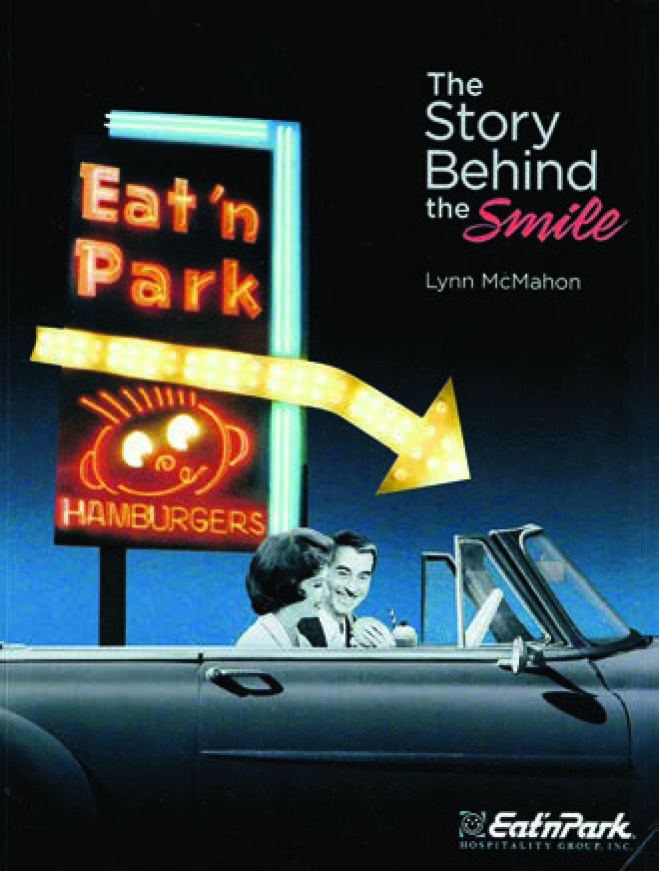 In 1933, Bob Wian sold his DeSoto roadster to buy a 10-seat hamburger stand in Glendale, California. Soon, he created a double-decker hamburger and adopted a chubby, cartoon kid with red-and-white checked overalls as a mascot. The Big Boy chain was born.
Unlike modern franchises, which build identical stores everywhere, Wian sold regional rights to use his iconic burger and advertising imagery to different people. You could get a Big Boy at Elby’s in West Virginia, or Shoney’s in the South, or Frisch’s in Ohio.
Larry Hatch had been working for Isaly’s dairy store chain in Pittsburgh when a friend suggested he visit Cincinnati to see a Frisch’s. Intrigued, he bought rights to Big Boy in Western Pennsylvania. [Attendees to the Niagara Falls conference learned about this in Brian Butko’s presentation about Isaly’s.] In 1949, the first Eat’n Park opened, and it remained tied to Big Boy until 1974. By then, Marriott Corporation had bought out Wian and was attempting to squeeze more revenue from its franchisees. With a strong local identity, Eat’n Park decided to separate and go its own way.
The Story Behind the Smile is a company history of what is today known as the Eat’n Park Hospitality Group. The Broadhurst family, who currently own the chain, chose Lynn McMahon as the author.
Company histories have strengths and weaknesses. With the owner’s support, McMahon had full access to the company’s archives. The book features numerous black-and-white and color photographs, advertisements, and interviews with employees. On the downside, with the company as the publisher, you can’t expect many negative things to appear. The harshest criticism is on page 37, where it states that the first owner, Larry Hatch, was a brilliant man but uncomfortable in social situations.
Where the book really shines is in describing the business decisions behind Eat’n Park’s growth. Originally a drive-in burger joint with limited indoor seating and car-hop service, in the 1970s, a decision was made to transform it into a more family-friendly restaurant. The menu was expanded, a salad bar was introduced, and a strong focus was placed on welcoming children. Eat’n Park met with the people from Mister Rogers’ Neighborhood and introduced their famous Smiley Cookie to appeal to the younger set.
This led to more changes. With a wider menu and more staff, Eat’n Park had to focus more on customer service, team management, and creating a company culture. Most books about restaurants don’t let you see these decisions being developed at the executive level. Other chapters address topics such as corporate philanthropy and responding to COVID, which follow the same approach.
More recently, Eat’n Park has moved beyond restaurants and added a contract dining division called the Parkhurst Division. They specialize in providing food for smaller colleges, corporate clients, and special events, such as Farm Aid. One of the more interesting parts of the book involved Eat’n Park’s hiring practices. As a privately held company, they have been able to focus on promoting people from within, or at least through personal connections. Jim Broadhurst had been working at PNC Bank as a commercial lending officer when he met Larry Hatch. Hatch recruited him to the company.
When Eat’n Park was considering adding in-house bakeries, a chance conversation between Broadhurst and an assistant manager at the Sewickley location, where she admitted she liked baking in her free time, convinced him to have her trained to run the bakeries everywhere. Mercy Senchur rose from waitress to chief operating officer of the restaurant division. Having a family atmosphere, loyal employees, and a caring approach to customers all seem to be ingrained in the company.
Although some SCA members might prefer a book less focused on the business side of Eat’n Park, this remains a good read, with plenty to engage most roadside enthusiasts. This book can be ordered from Globe Pequot or for less on Eat’n Park’s website.
Harold Aurand Jr. teaches history and American Studies at Penn State Schuylkill Campus. Sadly, there are no Eat’ n Parks around there. He only found the book when he stopped for lunch at one in Altoona on his way back from a conference
This book review originally appeared in the SCA Journal, Fall 2025, Vol. 43, No. 2. The SCA Journal is a semi-annual publication and a member benefit of the Society for Commercial Archeology.
More Book Reviews