

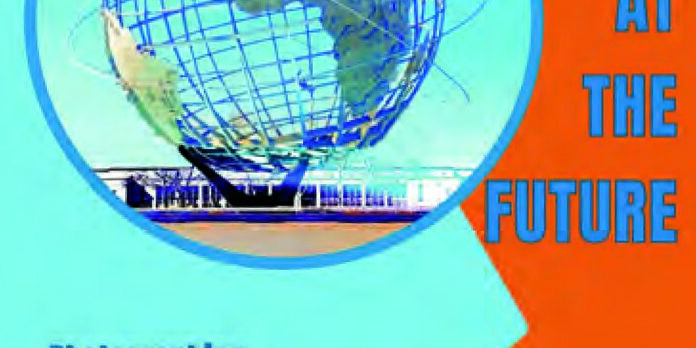
Looking Back at the Future: Photographing Vintage Leftovers of New York’s World’s Fairs
By loria R. Nash
New York: NRG Press, 2024, 2024
Softcover, 123 pages, $29.95
Reviewed by Douglas C. Towne
 During my childhood in Denver, among my father’s stories, three occupied the upper tier:
- Sweeping the sprint and broad jump events in a Jesse Owens-like track performance as a kid at the Omaha city championships in the 1930s.
- Almost conking President Dwight Eisenhower with a golf ball on the 9th green of the 479-yard par 4 at Denver’s Cherry Hills Country Club in the 1950s. (A Secret Service agent errantly waved my father to hit a blind approach shot to the elevated green, thinking he couldn’t reach it after chunking his tee shot).
- Experiencing the wonders of the 1939 New York World’s Fair as a 13-year-old, courtesy of his older sister, Norma, whose husband, George Hrdlicka, was doing a medical residency at Long Island College Hospital.
With the stars of the 1939 Fair, such as General Motors’ “Futurama” exhibit and Trylon and Perisphere, the oversized obelisk and globe practically in my DNA, it was with great interest that I read SCA member Gloria R. Nash’s recent book documenting the remnants of the 1939 and 1964- 65 New York World’s Fairs.
Nash, too, carries the World’s Fair DNA from her childhood, as she watched in awe the light shows and fireworks from the 1964-65 Fair from her family’s apartment in Queens. She was also a frequent fair visitor. “Even at ages 10 and 11, I sensed the fair would be among the highlights of my life,” Nash writes. “More than a group of buildings, they represented an energy that defined the pinnacle of the era’s creativity in architecture, art, design, engineering, industry, and technology. Fairs also tended to be shared events that elicited a universal ability to uplift and unify all people without concern for differences in social standing, class, culture, or age.”
In a serendipitous connection, the book continues Nash’s high school photography class assignment from 1969, in which she documented relics from the fair. As a commercial archeology sleuth, Nash excels at uncovering stone markers etched in curbs, subway cars built especially for the line constructed to the fair, and stone bas-relief wall carvings incorporated into a recent construction. I can imagine the author showing up at odd times to catch these remnants in the proper light, broom in hand to sweep away leaves and other detritus for an exceptional photograph.
But Nash bumps up the difficulty of her mission by also including World Fair relics adaptively repurposed elsewhere. Some unmistakable items from the 1939 Fair, like the 262-foot-tall Life Savers Parachute Tower in Coney Island or the Peter Stuyvesant statue in Manhattan, didn’t require a lot of investigation. Others, however, were impressive finds, like five of the 11 60-foot-tall steel arches that served as message centers for the 1964-65 Fair and were repurposed to serve new lives in New York, Rhode Island, and Ohio.
Although it’s not a history of the two fairs, Nash’s book offers sufficient background to appreciate and understand their dynamics. For example, the main goal of the 1939 Fair was for renowned urban planner Robert Moses to transform an ash dump into the municipal park that became Flushing Meadows Corona Park in Queens. Indeed, there was a brief push to further develop an East Coast Disneyland at the park following the 1964-65 Fair.
Amazingly, both fairs were considered financial failures because of lower-than-projected attendance. Nash refutes this perspective: “Despite financial losses and accusations of mismanagement, the two fairs succeeded in shaping visitors’ views of a future filled with peace, optimism, and joy.”
Nash thinks the fairs’ substantial impact on attendees resulted from a Utopian future created by “…the finest, most talented visionary designers, artists, and architects to create once-in-a-lifetime designs no one would forget.” From the 1964-65 Fair, this would include Welton Becket, Buckminster Fuller, Roy Lichtenstein, Eero Saarinen, and Andy Warhol.
As for the paucity of remnants, most venues were built as temporary structures, and demolition started the day after the fair closed. “There were no plans, no future to consider,” Nash writes. Even those supposed to be retained as inspiring symbols, such as Trylon and Perisphere, became caught up in world events and were melted down for World War II armaments. Some pavilions lasted decades after the fair, waiting to be repurposed, only to be razed after vandalism and postponed maintenance made preservation challenging.
After thoroughly enjoying the book, I realized that my favorite aspect is not the impressive discoveries of remnants but rather the book’s genesis. Nash had moved back to Queens from Manhattan to care for her elderly mother, which limited her traveling. Soon afterward, road trips disappeared completely when the pandemic hit.
Nash used the period to reconnect with the nearby Flushing Meadows Corona Park for the first time in 50 years. After two years of research, she’s created a worthy addition to the commercial archeology library. It’s such an SCA thing to do, creating a definitive work about a childhood passion, and she deserves much kudos. Is the book perfect? No, it could have benefited from additional design work and editing. But does it accomplish its mission—absolutely! Read the book as Nash looks back on these events with delight, and New York World’s Fairs might become your passion, too.
Douglas C. Towne is the editor of the SCA Journal. He fondly remembers SCA tour guide Kevin Patrick standing in front of the Unisphere, the symbol of the 1964-65 New York World’s Fair, on the last day of the North Jersey Diner Tour in 2015, discussing how F. Scott Fitzgerald’s novel, The Great Gatsby was tied to the history of Flushing Meadows Corona Park in Queens.
This book review originally appeared in the SCA Journal, Spring 2024, Vol. 42, No. 1. The SCA Journal is a semi-annual publication and a member benefit of the Society for Commercial Archeology.
More Book Reviews