


Hand Painted
By Tom Palazzolo
Self published, 2024, 2024
Softcover, 100 pages, $25
Reviewed by William Swislow
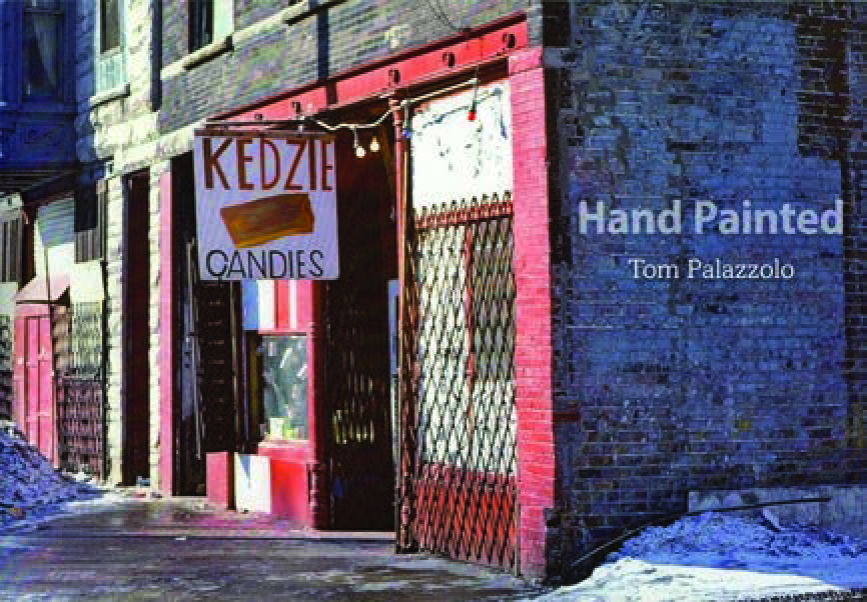 The golden age of roadside neon is, of course, long past, but at least the surviving signs are increasingly recognized as local, even national, treasures. Another once ubiquitous roadside art form, the hand-painted shop sign, has received much less recognition despite its even more precipitous decline.
Weathering inherently limits the lifespan of painted signs, with the advent of cheaply made plastic versions accelerating their disappearance. The easy availability of pre-existing art via digital channels also provides a firm nail in the coffin. While you can still find some survivors hanging on amidst the generic imagery, it requires a look into the past to sample these bits of roadside decoration in any quantity.
Tom Palazzolo is a Chicago experimental filmmaker and photographer who has made a specialty of cultural cul-de-sacs. His catalog includes 1984’s At Maxwell Street film, about Chicago’s historic flea market. His photographs have also been published in several books, including a 2008 At Maxwell Street volume and 2019’s Clark Street, exploring a now-gentrified strip that was very rough-and-tumble when he photographed it in the late 1960s and early 1970s.
Now, with the help of his collaborator on the Clark Street book, designer Don Di Sante, he has come out with Hand Painted, featuring 90 photos of hand-painted business signs around Chicago from the early 1970s and ’80s.
Many of the images feature conventional subjects, though not always conventionally rendered, like the beauty salon sign that appears to show a pair of scissors penetrating a woman’s head, or Michael Jordan shooting a ball into a tire for a basket. You’ll find funky hot dogs and hamburgers, natty clothes and broken TVs, tow trucks, teeth and shapely barber poles, pool tables and video games. There are plenty of auto parts — I particularly like the painting of a man chasing a wheel with a tire iron.
A number of these signs have the dimensions of murals, though none are the conventional wall signs now more or less widely celebrated as ghost signs. Many others were executed on smaller signboards.
These roadside flights of creativity make a small business’s street presence a lot more dynamic. Still, inevitably, they fade or crumble away or just get painted over — sometimes before the store itself has started failing, as so many small enterprises do. (Nearly all the businesses advertised in Hand Painted have long since vanished.)
Even the precious bits of roadside art that might have survived years of weather and neglect are still liable to disappear without a trace when a new use is found for a space or a building is demolished. Compared with neon signs, the market for these less heroic hand-painted versions is hardly thriving. While there certainly are folks who have treasured and acquired some of these signs, a collector or museum is less likely to swoop in at the last minute to buy the remnants or fund a restoration.
Many of the signs were executed in ways that very much parallel the making of folk and outsider art. The artists, we can presume, rarely operated with any connection to art history, other than signs and advertisements they had seen on the roadside. At most, they might have had a sense of being part of a pop-culture art form, perhaps with mentors or teachers coming out of the sign-painting tradition. This scenario would likely be true whether the artist was a professional sign painter or someone producing an ad hoc image because their business, or a friend’s business, needed one. Their artistic goals would not have been too ambitious, and the constraints are clear: get across a message for the business, do it in the limited space available, and make it memorable. Communicate what you need to, with not much expectation of recognition beyond “cool sign” (if that).
Most important for the rest of us, these signs in the service of small commercial enterprises make the streetscape far more interesting. And we should especially appreciate those who, like Palazzolo and, say, John Baeder, documented this largely ignored and unrespected artwork as a labor of love. That took some commitment in the days before digital photography and camera phones made recording it so much cheaper and easier.
Like many who fancy roadside art, Palazzolo would stop and photograph signs of interest as he passed by (in this case, the more handmade the better), documenting a commercial world that has vanished.
“Driving in and around Chicago since the ’60s, I began to notice homemade signage for neighborhood establishments and found them visually appealing. With my 35 mm camera, a constant traveling companion, I started documenting them,” he says in the book.
Hand-painted signs still can sometimes be found here and there in the U.S. (the art remains vibrant in other places), but books like Palazzolo’s remind us of the spontaneous vernacular art galleries that once packed our city streets.
You can purchase at Chicago’s Buddy Shop or online at https://hi-buddy.org/search?q=Palazzolo.
Bill Swislow was a founder of Cars.com. When not looking for hand-painted signs on the roadside, he amassed one of the world’s largest collections of anonymous bottle-cap figures, which can be viewed at his interestingideas.com website.
This book review originally appeared in the SCA Journal, Fall 2025, Vol. 43, No. 2. The SCA Journal is a semi-annual publication and a member benefit of the Society for Commercial Archeology.
More Book Reviews