

SCA Editor’s Word
A Noble and Miraculous Endeavor: Creating Casa Grande’s Neon Sign Park
By Douglas Towne
Casa Grande’s downtown park is a gas — neon gas, specifically. Its elements flicker to life at dusk, creating a buzz that lasts until 11 p.m. Whether an evocative name like Hotel Sacaton or a more pedestrian moniker like Goddard Shoes, the neon signs glow in the Arizona darkness as if drawn with a magical luminous pen.
Burning brightly in the night, these signs, which once promoted Casa Grande businesses, have found a second career as objets d’art in the public space.
The featured signs, using noble gases such as neon and argon for illumination, are primarily products of the post-World War II economic boom. Their designs, which capture the period’s unbridled optimism, have received acclaim as American folk art. But when their mom-and-pop businesses closed, these orphaned signs lost their purpose and almost their existence. Casa Grande, not wanting to lose the sense of place created by these local landmarks, set out to preserve them in a vintage sign park. But it wasn’t an easy task to get the lights turned on.

Marge Jantz basks in the glow of neon in the Grande Central Station Information Center, 2023. All photos by Douglas Towne unless noted.
Casa Grande’s commercial landscape, encountered by motorists in the Roaring ’20s, included signs advertising the goods of local merchants as well as those promoting gas, food, and lodging, primarily on Arizona Highway 84. The road was a shortcut between Tucson and Gila Bend for travelers on U.S. Highway 80, a cross-country thoroughfare with more traffic than Route 66.

Sunset Court on Arizona Highway 84, 1937. Postcard from Marge Jantz.
Memorable signs from this pre-interstate era still grace the city’s roadside, including those advertising the Boots n’ Saddle Motel, Cotton’s Wonder Bar, and the Se-Tay Motel. Sophia’s Restaurant is long defunct but still has its unique, though unlit, neon fountain sign. Many signs vanished over the years, but some were saved and donated to local organizations.
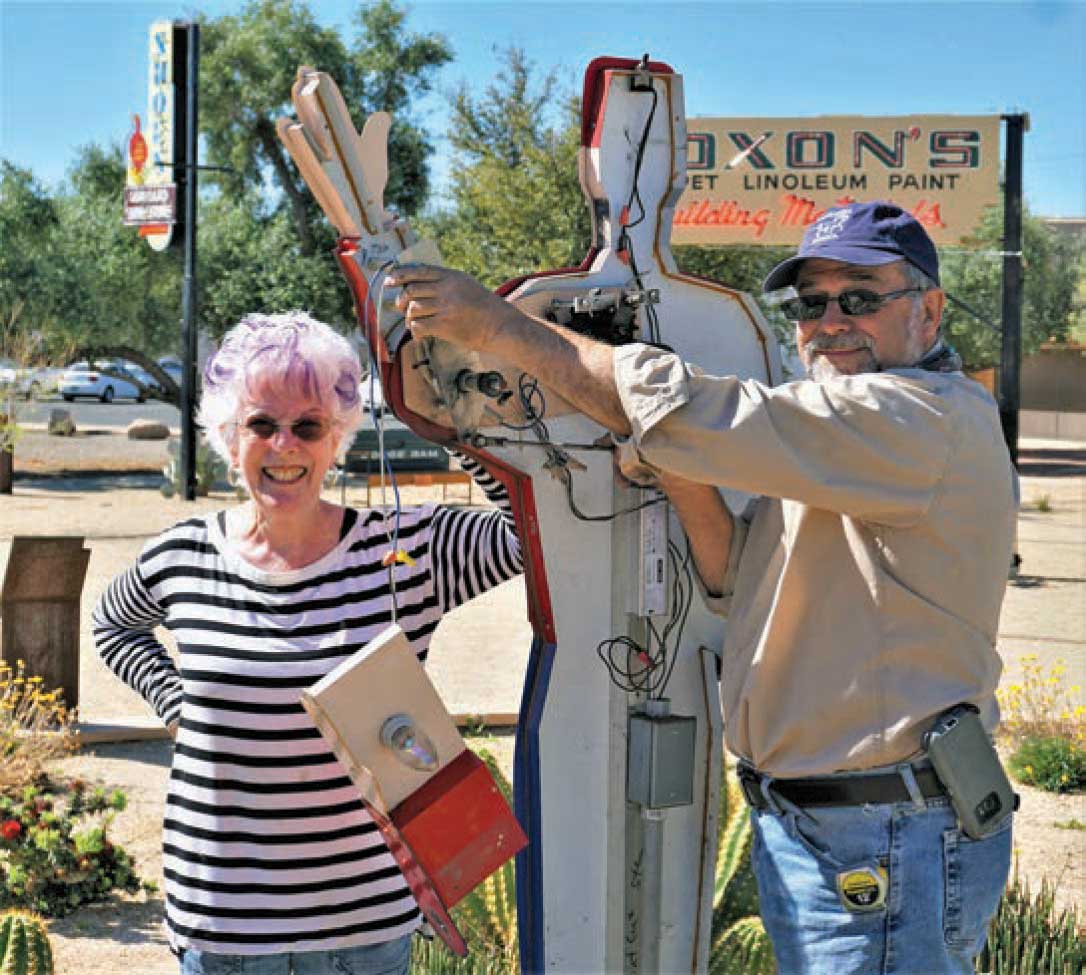
Marge Jantz and Jude Cook repair the park’s mechanical bellhop, 2021.
Amidst this darkening of the city’s heritage, a ray of light appeared from an unlikely source. In 2016, Marge Jantz, an energetic Scottsdale transplant and SCA member with swirls of purple running through her silver hair, believed that relit historic signs would be a catalyst for revitalizing the city’s downtown.
“I have an extravagant fondness for the color and flash of neon signs,” she confesses. As the then-chairwoman of the city’s Historic Preservation Commission (HPC), Jantz led efforts to secure a grant for a Historic Resource Sign Survey and to partner with Casa Grande Main Street to raise funds for the restoration of the collected orphaned signs. Most importantly, she used her effervescent personality to cajole a rent-free space downtown for the sign park.
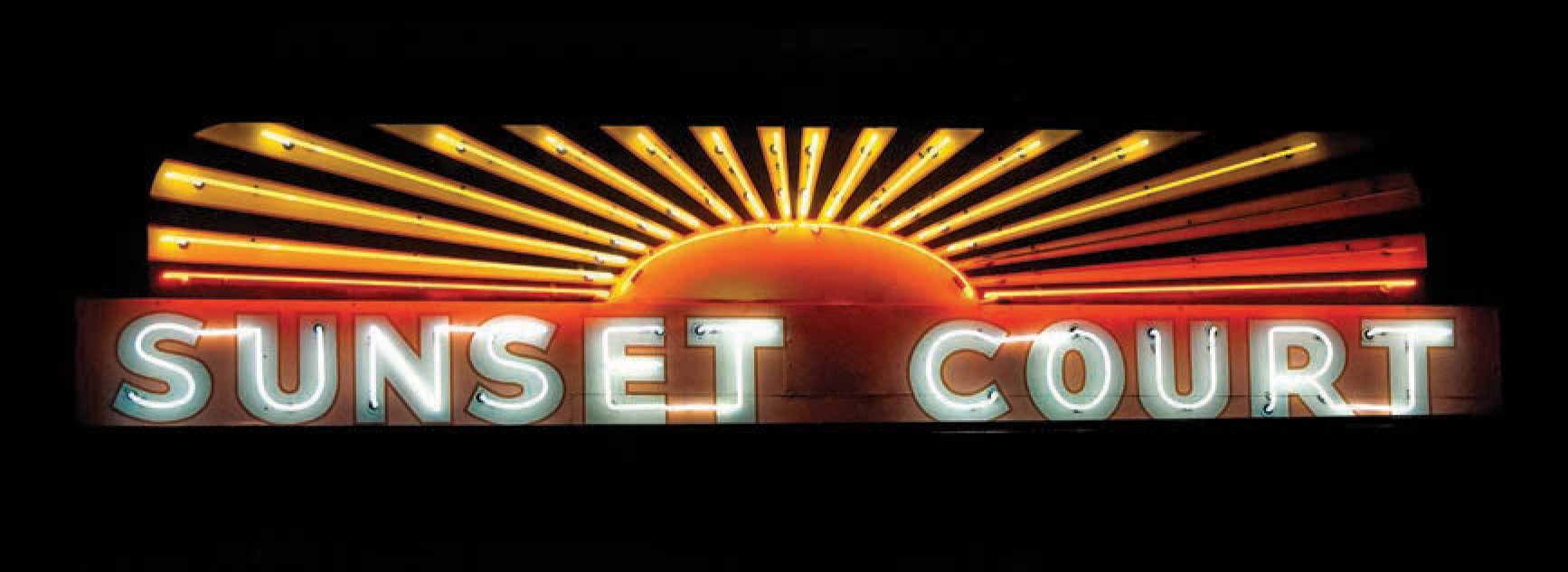
Sunset Court sign, 2023.
The commission’s initial project was the 1940s-era Sunset Court sign. The HPC rescued it in 2013 and, four years later, mounted the refurbished sign on the side of the Western Trading Post building downtown. The Sunset Court sign was relit and became part of a Highway 84 History Trail mural featuring historic local landmarks.
Jantz’s initial efforts also met a disappointing loss: the Silver Bullet Cocktails sign that had advertised the eponymous bar on Arizona Route 387 since 1956. The pole sign had a neon cocktail glass above its name and a giant arrow with chaser lights below it.

Silver Bullet sign in Ankeny, Iowa, 2018. Photo by Marilyn Gallagher.
In 2016, with the building in foreclosure, a sign picker came through town. “The local branch bank manager sold the sign with no thought of preserving our local sign history or supporting the city’s Historic Preservation Commission,” Jantz says. Things then took a strange turn with the sign, resulting in a flicker of hope for its return.
A bar owner in Ankeny, Iowa, had paid $2,000 for the Silver Bullet sign and an additional $1,500 for it to be packaged and delivered to a sign company in Grand Island, Nebraska, for refurbishment. But the sign failed to arrive at its intended destination. The shippers claimed delays due to mechanical breakdowns and illness until communication ceased for a good reason: they had pawned the sign for $2,100 in Phoenix.
An unsuspecting person bought the Silver Bullet sign at the pawn shop and offered it on Craigslist for $2,500. “A friend of mine saw the posting, notified me, and word was passed to the Iowa owner,” Jantz says. Law enforcement located the shippers and charged them with theft, then went undercover as prospective buyers and confiscated the Silver Bullet neon sign. Three months later, the sign finally made it to Nebraska for restoration and was subsequently displayed at the Fletcher Kitchen & Bar in Ankeny. The owner said that if the restaurant ever closed, he would return the sign. The Fletcher closed in 2022; no word has been received on whether the sign will be returned to Casa Grande.

SCA members Douglas Towne, Steph Carrico, Jeff Ebersole, Jeremy Ebersole, and Marge Jantz, 2023.
Despite the loss of the bar sign, the restored Sunset Court sign raised public awareness about the city’s historic resources. In 2017, Casa Grande Main Street entered its proposed vintage sign park in the Partners in Preservation: Vote Your Main Street competition sponsored by the National Trust for Historic Preservation. “I think people were both in awe and disbelief that our small community could compete in a nationwide contest with such high stakes,” Jantz says. Casa Grande won a $144,000 grant, coming in second, ahead of 23 other projects, including those in Los Angeles, Cincinnati, and Salt Lake City.
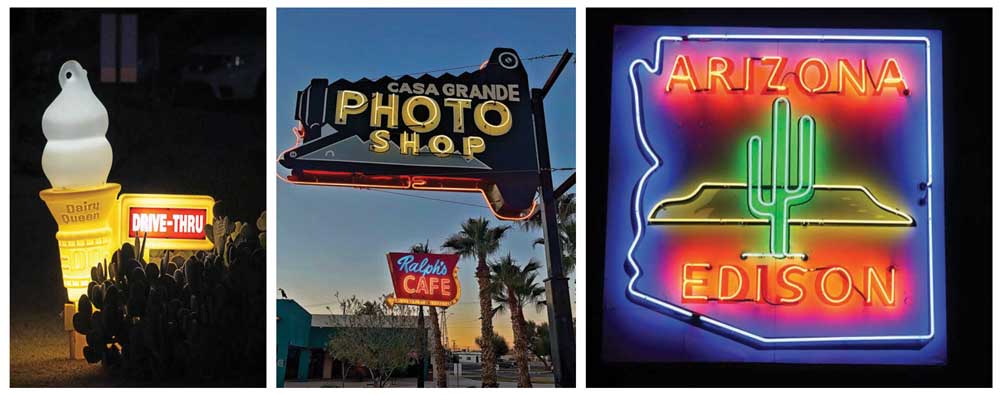
Signs at Casa Grande Neon Sign Park, 2023.
Jantz expanded the sign park’s collection to 14 signs. The Kramer family, which owns the adjacent Casa Grande Valley Newspapers Inc., lent its property for the park, which links downtown with the Arts & Culture District. Cook & Company Signmakers in Tucson, owned by Jude and Monica Cook, who also founded the Ignite Sign Art Museum, installed all the signs. They restored nine and manufactured three additional ones. Graham’s Neon in Mesa restored two others. Jantz is expanding the park to include a windmill and metal art, to celebrate the city’s agricultural history. For her extraordinary efforts, Jantz was recently the recipient of the Governor’s Heritage Preservation Honor for Lifetime Achievement. She’s part of a rare daily double, having been part of the team that was selected for the same honor for Casa Grande’s Neon Sign Park in 2020.

Metal art and windmill celebrating the city’s agricultural history, 2025. Photo by Marge Jantz.
Casa Grande’s Neon Sign Park is part of a nationwide movement to display orphaned signs. “This is great for nostalgic locals and design-loving tourists,” says Debra Jane Seltzer, former SCA columnist. “It keeps the signs in their outdoor element, where they were meant to be seen.”

SCA board member Jeremy Ebersole and his father, Jeff Ebersole, are benefactors of the sign park.
Sign parks are considered a last resort in preservation, as business owners are encouraged to leave their signs on-site when possible. “Without vintage signs, the entire country will be characterless, with nothing but chain stores from coast to coast,” Seltzer says. “When we travel, there will be no regionalism, no fun, no design, and nothing to photograph.”
Tod Swormstedt, founder of the American Sign Museum in Cincinnati, says several public displays of vintage neon signs are popping up across the U.S. and calls out Jantz for accomplishing the near-impossible. “Casa Grande is certainly one of those little gems to see and experience,” he says. But what I think is perhaps even more of an accomplishment is having created this on someone else’s property. I can only imagine the negotiations, legal issues, and liability concerns that must have been experienced. I’m sure the public can’t fathom the logistics involved, but they can surely enjoy it.”

Casa Grande Neon Sign Park, 2023.
Swormstedt notes that the evolution of vintage signs from marketing tools to an integral part of a city’s aesthetic is driven by a powerful yet unseen factor. “I think the common thread that runs through preserving vintage signs is emotional,” he says. Signs are a proverbial walk down memory lane, and they almost always evoke fond memories.
Casa Grande has capitalized on this sentiment and is letting the good times glow.
Did you enjoy this article? Join the SCA and get full access to all the content on this site. This article originally appeared in the SCA Journal, Fall 2025, Vol. 43, No. 2. The SCA Journal is a semi-annual publication and a member benefit of the Society for Commercial Archeology.
More Articles Join the SCA