

All about the Burger: A History of America’s Favorite Sandwich
By By Sef “Burger Beast” Gonzalez
Coral Gables, Fla.: Mango Publishing, 2019, 2019
Softcover, 227 pages, $16.99
Reviewed by Paul Sherman
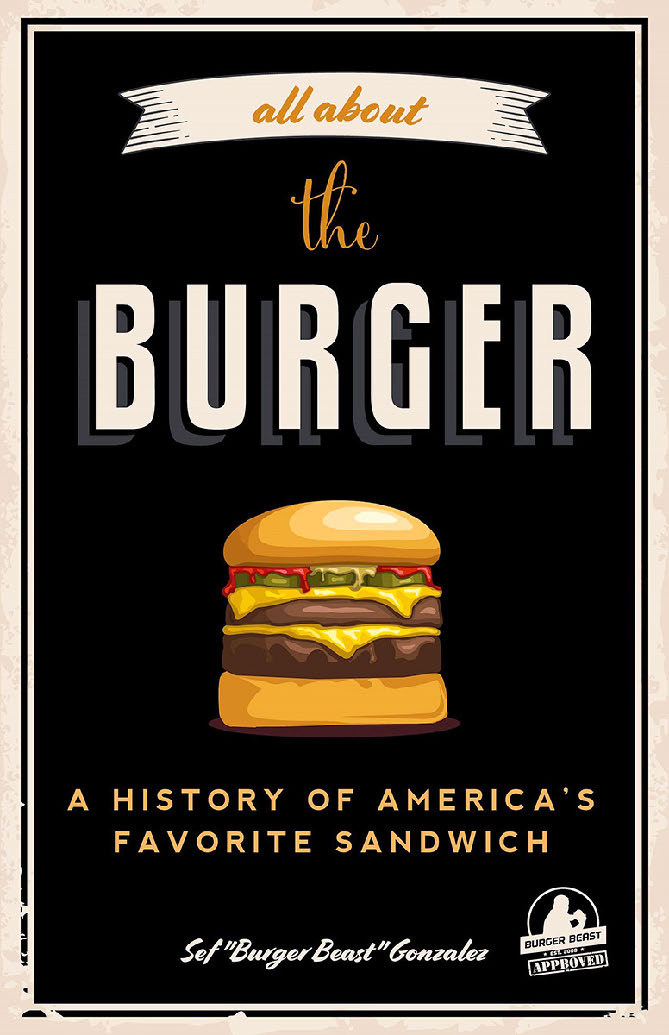 The title of All About the Burger: A History of America’s Favorite Sandwich is misleading. Sure, in some sense, there is a history of the hamburger here, though that history comes from a very limited perspective. In reality, the account that burger-blogger-turned-author Sef Gonzalez offers is much more about burger chains than actual burgers. There is, of course, nothing inherently wrong with that. Yet, even if it were titled more appropriately, Gonzalez’s chain-centric burger history would still be superficial and only mildly interesting.
When All About the Burger is not devoting separate chapters to White Castle, McDonald’s, Burger King and Wendy’s, it is filling up many of its other sections with laundry-list mini-histories of defunct chains, regional chains and “better burger revival” chains. Unfortunately, the information here concerning founders, family members, original location addresses and first franchisees comes off more like trivia than insightful information serving the larger story of the impact “America’s favorite sandwich” has had on the country’s culture. That’s because Gonzalez offers up this info—much of which seems to be merely gleaned from company histories—without the benefit of any analytical framework that could put it into a more exciting and more substantial context.
Gonzalez simply did not do the level of research necessary to reflect the forces that helped the burger become such an essential part of American life. Undoubtedly, the taste of the sandwich was not the only reason for the rise of the burger. Cultural and economic forces were essential, too. There’s a fascinating, textured “burger history” to be told, but All About the Burger betrays the first word in its title.
Although some larger forces are mentioned in passing, the book could have significantly benefited from tangential yet potentially valuable looks at some such effects, including: technological advances in the production, distribution and preparation of beef, potatoes and milk, the staples of any burger chain; innovations in fast-food restaurant and sign design; the evolution of franchising, a business scheme that comes up repeatedly in the tale of chain expansion and founder wealth, but could have been conveyed in a more meaningful way; the changing role of refrigeration (chains’ use of frozen versus never-frozen patties and fresh versus frozen potatoes); the rise of car culture and postwar consumerism; the soft-drink industry and its relationships with burger chains; American eating habits and changes in portion sizes (there must be discourse to mention on whether burger chains caused or just reflected increased eating); and changes in advertising and media. No doubt there are other significant issues affecting chains that a “burger expert” would know that didn’t occur to this reader, perhaps zoning changes or employee relations.
Gonzalez seems to be very qualified to write a “my favorite burgers” sort of book, though the fact that he includes very little on the country’s many decades-old mom-and-pop burger restaurants (which have histories at least as interesting as most chains) makes one wonder about that. But a favorite-burgers guide is not the book he set out to write with All About the Burger. His comprehensive history has a blog-level depth of research that feels flimsy between two covers.
Considering that this society’s conference attendees once traveled to a remote field in New Mexico to commingle with a set of A & W Burger Family fiberglass statues, SCAers would eat up a tasty burger history. Alas, this is not it.
This book review originally appeared in the SCA Journal, Fall 2019, Vol. 37, No. 2. The SCA Journal is a semi-annual publication and a member benefit of the Society for Commercial Archeology.
More Book Reviews