


Historic Anheuser-Busch eagle sign from Newark coming to St. Louis

An Anheuser Busch facility is seen Monday, June 30, 2008, in Newark, N.J. AP Photo/Mel Evans
From Fox2 Now: ST. LOUIS – A towering symbol of Anheuser-Buch history is coming to St. Louis.
A historic neon-lit eagle sign that long stood atop the company’s Newark, New Jersey brewery will be relocated to St. Louis, according to an A-B spokesperson.
The spokesperson confirmed that the large-scale, illuminated sign will be moved from Newark to the company’s St. Louis headquarters, where it will be preserved and displayed to the public.
Fire destroys historic roadside motel on Sunset

The historic neon sign survived a fire that destroyed a 1905 house that once served as the Hollywood Center Motel’s office.
From Beverly Press: The Hollywood Center Motel, a roadside fixture on Sunset Boulevard that opened in the 1950s but more recently became vacant and fell into disrepair, went up in flames in a major fire around 4:30 a.m. on Jan. 4 that took 70 firefighters more than hour to extinguish. Afterward, the city declared a house on the property a public safety risk and it was demolished by the Los Angeles Fire Department.
LAFD Capt. Adam VanGerpen said firefighters rescued a man from the building and took him to the hospital in stable condition. The property was fenced and the building was supposed to be unoccupied, but squatters had gained access many times over the past year. LAFD spokeswoman Jennifer Middleton said the LAFD responded to three or four previous fires at the former motel. The exact cause remains under investigation by the arson unit, she added.
Sausalito restaurant famed for rock star clientele closes permanently
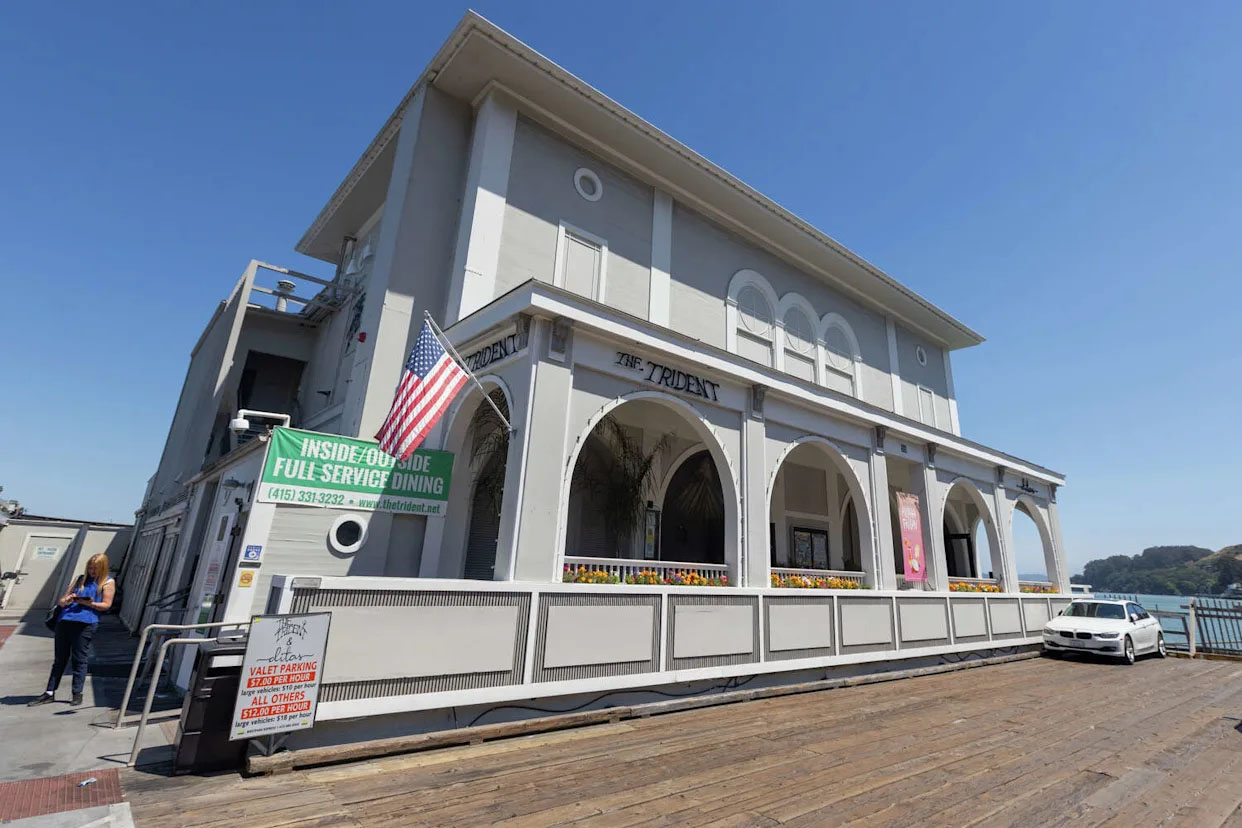
The Trident restaurant sits above the San Francisco Bay in Sausalito, Calif. on July 3, 2024. Douglas Zimmerman/SFGATE
From SFGate: A Sausalito staple has served its last tequila sunrise: The Trident closed its doors on New Year’s Eve after 127 years on the waterfront.
The Bay Area restaurant started life in the late 1800s as the site of the San Francisco Yacht Club. For decades, it was home to the yacht club’s events and galas, but when the group moved in the 1920s, the building turned into a jazz club. The Trident transformed into a true Bay Area landmark in 1960 when it came under the ownership of the famed folk band the Kingston Trio. As the counterculture movement thrived in San Francisco, the spot was renamed the Trident.
Zion National Park To Restrict Large Vehicles Traveling The Zion-Mt. Carmel Highway

Zion National Park will implement restrictions on large vehicles traveling the historic Zion–Mt. Carmel Highway starting in June. NPS file.
Zion National Park will implement restrictions on large vehicles traveling the historic Zion–Mt. Carmel Highway starting June 7, 2026. The change is meant to improve safety, preserve historic features, and reduce delays on the 10.7-mile route.
After June 7, vehicles larger than 35 feet, 9 inches in length; 7 feet, 10 inches in width; 11 feet, 4 inches in height; or 50,000 pounds will no longer be permitted to drive the highway between Canyon Junction and the park’s East Entrance. Combined vehicles, such as trucks with trailers, cannot exceed 26 feet from hitch to rear axle and 50 feet overall.
The restrictions are based on two safety studies conducted in 1989 and 2019 and validated by the U.S. Department of Transportation’s Federal Highway Administration. The studies found:
- A single vehicle over 35 feet, 9 inches long or combined vehicle over 50 feet long (including no more than 26 feet from hitch to rear axle) cannot safely maintain their lane along the ZMCH.
- Vehicles wider than 7 feet, 10 inches or taller than 11 feet, 4 inches cannot pass through the Zion-Mt. Carmel Tunnel in a single lane of travel.
- Vehicles over 50,000 pounds exceed weight limits on four bridges along the ZMCH.
Completed in 1930, the Zion-Mt. Carmel Highway is listed on the National Register of Historic Places and is a designated Historic Civil Engineering Landmark. Its bridges, tunnels, and sharp switchbacks were built in an era with smaller, lighter vehicles, and large vehicles increase the risk of damage to historic infrastructure that was not designed to accommodate them.
Bowling Alone, or Not at All, by Robert Elias

Elks Lodge Bowling Team, c. 1950s. Marin History Museum Collection.
From the Marin History Museum: In his 2000 book Bowling Alone, Harvard professor Robert Putnam lamented America’s decline in social and community life. He used the sport to represent the loss of membership and involvement by Americans in organized civic organizations, such as PTA’s; political parties; church, neighborhood and volunteer groups; and bowling leagues. Putnam worried about the consequences, fearing the weakening of the social fabric required for a healthy society and democracy. He was alarmed by the shift to more individual pursuits and its correlation with public alienation, lower educational performance, poor public health, greater teen delinquency, and higher crime rates.